Researchers unlock scalable control of quantum light signals
About Optica
17 June 2026
Researchers unlock scalable control of quantum light signals
New approach could enable precise manipulation of information carried in different frequencies of light, supporting highly parallel processing on photonic chips
WASHINGTON — Researchers have discovered a new, highly scalable way to control quantum information carried in different frequencies, or wavelengths, of light. The advance brings frequency-domain quantum information processing — a promising approach to photonic quantum computing — closer to practical implementation.

Caption: Integrated acousto-optic devices being developed at Sandia, such as the eight-inch wafer shown here, are key to the new scalable method for controlling quantum information carried in different frequencies.
Credit: Craig Fritz“The appeal of frequency encoding for quantum computing is that, in theory, hundreds of channels of information can run through a single, on-chip waveguide, allowing certain operations to be performed completely in parallel,” said Nils T. Otterstrom from Sandia National Laboratories. “However, scaling up reconfigurable optical processors for frequency encoding has been extremely challenging, particularly on chip.”
In the Optica Publishing Group journal Optica Quantum, Otterstrom and Joseph M. Lukens from Purdue University describe and computationally validate their new approach, which uses acousto-optic frequency beamsplitters to split light into different frequencies within the same waveguide. The work represents an important step toward photonic chips that provide a highly scalable way to process quantum information, which could ultimately lead to computers that help tackle complex problems in chemistry, materials science and secure communications.
“By combining state-of-the-art integrated photonics with new quantum information processing concepts, this approach makes it possible for quantum information to be encoded in frequencies of light,” said Lukens. “This allows hundreds of frequency channels to be carried in a single waveguide, greatly increasing the amount of information that can be processed in a compact chip-based system.”
Scaling up quantum systems
Otterstrom, who specializes in integrated photonics, and Lukens, an expert in quantum frequency encoding, have a long-standing collaboration focused on developing frequency domain quantum information processing in an integrated photonics platform — a system that generates, manipulates and detects light on a single microchip.
In this new work, they tackled the challenge of manipulating an individual frequency-encoded channel among the hundreds running through a single, on-chip waveguide. Previous technologies have addressed this goal by breaking the channels into many separate waveguides during processing, but this makes it impractical to scale up frequency-based photonic quantum computers.
“We were able to build on Joe’s ideas and transform them into programs here at Sandia National Laboratories, where we have the facilities to build photonic systems using standard microelectronics fabrication processes,” said Otterstrom. “We have been exploring how technology developed here, particularly in acousto-optics, could be applied to frequency-domain quantum information processing.”
Acousto-optic modulators convert electric fields into acoustic vibrations, which then change the frequency of light passing through them. Although these devices are available commercially, they are large, require precise alignment and lack customizability.
Solving the complexity barrier
“Early on, I recognized that acousto-optic modulators could be useful for frequency processing but thought they would be extremely complicated and had dismissed them as not practical,” said Lukens. “Then I found out that because of the work that had been done at Sandia on integrating acousto-optic modulators onto a chip, all the problems and difficulties I was worried about had in many ways been solved.”
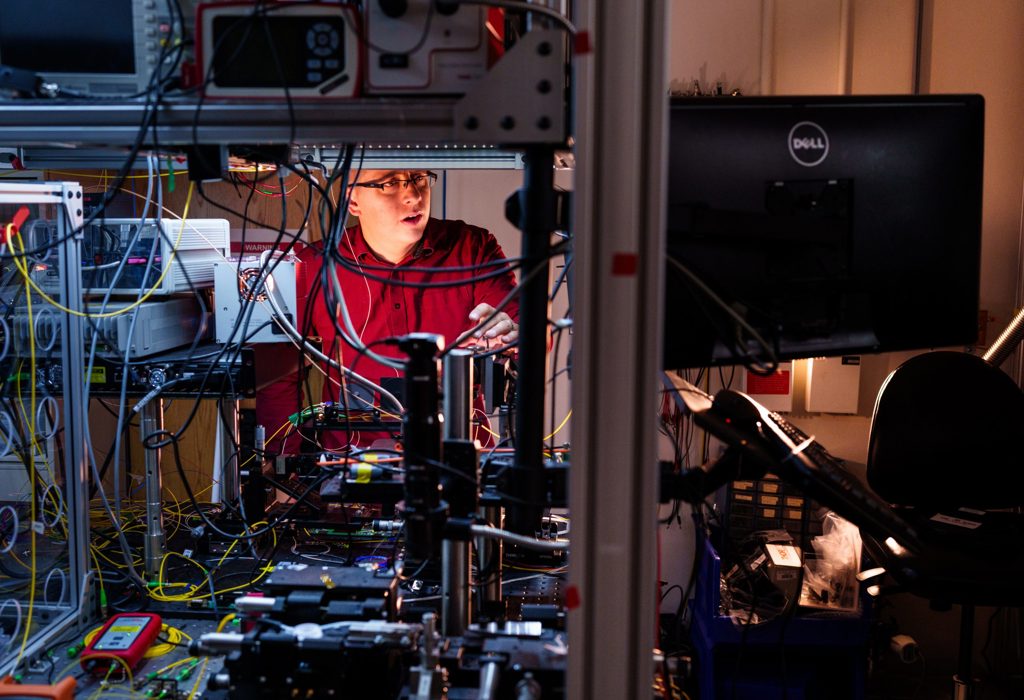
Caption: Nils Otterstrom works to align an integrated photonics chip as part of work to combine integrated photonics and frequency-encoded quantum information processing.
Credit: Craig FritzDrawing on this work, the researchers designed integrated acousto-optic frequency beamsplitters that make it possible to perform scalable operations while splitting frequencies into only two waveguides, regardless of the number of channels. This allows quantum information to be encoded in frequency rather than the more traditional methods of using spatial paths or polarization states.
The researchers used modeling to test their new approach for controlling frequency-encoded states of light. The results showed that it is feasible to achieve high-fidelity quantum operations using existing integrated photonics technology, demonstrating the possibility of parallel operations that achieve 100% bandwidth utilization.
Over the past five to six years of developing intermodal acousto-optic devices, the researchers have demonstrated near-100% mode and frequency conversion with minimal propagation loss as well as the ability to achieve both broadband and narrowband operation. These results point toward the feasibility of implementing this full quantum information processing paradigm in integrated photonics.
Paper: J. M. Lukens, J. H. Dallyn, H.-H. Lu, N. I. Wasserbeck, A. J. Graf, M. Gehl, P. S. Davids, N. T. Otterstrom, “A paradigm for universal quantum information processing with integrated acousto-optic frequency beam splitters,” 4, 295-304 (2026).
DOI: 10.1364/OPTICAQ.592034.
About Optica Publishing Group
Optica Publishing Group is a division of the society, Optica, Advancing Optics and Photonics Worldwide. It publishes the largest collection of peer-reviewed and most-cited content in optics and photonics, including 19 prestigious journals, the society’s flagship member magazine, and papers and videos from over 1200 conferences. With over 520,000 journal articles, conference papers and videos to search, discover and access, its publications portfolio represents the full range of research in the field from around the globe.
Media Contact
