New chip-scale gyroscope measures rotation with unprecedented sensitivity
About Optica
14 October 2026
New chip-scale gyroscope measures rotation with unprecedented sensitivity
Optical ring-laser device can detect rotation as slow as 37 degrees per hour, with potential applications in precision navigation
WASHINGTON — Researchers have developed a chip-scale optical ring-laser gyroscope that can measure rotation as slow as 37 degrees per hour. This record sensitivity, approaching Earth’s rotation rate of 15 degrees per hour, could eventually be useful for precision navigation and orientation systems, particularly where GPS is unavailable. Gyroscopes measure how an object rotates, helping determine its orientation and movement. The chip-based gyroscopes found in smartphones and other everyday devices tend to have limited sensitivity, making them unsuitable for some demanding applications. This has driven scientists to develop chip-based versions of optical gyroscopes, which are sensitive enough for applications such as aircraft navigation.
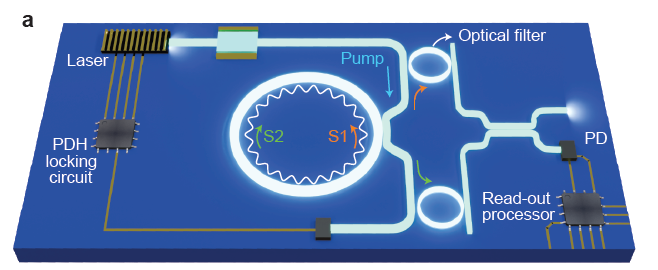
Caption:Researchers developed an integrated Brillouin laser ring gyroscope that measures rotation as slow as 37 degrees per hour. This image shows a conceptual schematic of the chip-based gyroscope.
Credit:Kerry Vahala, California Institute of Technology
“Our new gyroscope combines several advanced technologies to achieve a high level of sensitivity in a format that can be made with standard CMOS chip-processing methods and uses just milliwatts of optical power,” said Daniel J. Blumenthal, who led the research team from the University of California, Santa Barbara. “A fully integrated optical gyroscope would not only be smaller than today’s systems but also have no moving parts and thus be very resilient to vibrations and shocks.” In the Optica Publishing Group journal Optics Letters, the researchers describe the new device, which is based on a special type of low-noise laser made using a photonic integrated circuit made of silicon nitride waveguides. Its sensitivity represents a nearly 2,000-fold improvement over the researchers’ earlier silicon nitride Brillouin gyroscope, which measured rotation at 72,000 degrees per hour. “With more development, this type of optical gyroscope could eventually bring the high-precision sensing of optical gyroscopes to compact, chip-based devices,” said Kerry Vahala, who led the research team from the California Institute of Technology. “That could offer a more mass-manufacturable and rugged device for application in cars, aircraft and spacecraft.” Bringing technologies together To create the new gyroscope, the researchers combined a Brillouin laser gyroscope approach developed by Vahala’s research team with a Brillouin laser-on-a-chip based on a silicon nitride platform developed by Blumenthal’s group, working with the Air Force Research Laboratory. Brillouin gyroscopes use light interacting with vibrations in the waveguide to create the low-noise laser signals needed for rotation sensing.
The gyroscope approach developed by Vahala’s research team is based on a ring-shaped microresonator that can confine light with very little loss and has a high quality (Q) factor, a measure of how well the ring holds light. This allows light to circulate many times, making it extremely sensitive to small changes caused by rotation. In 2017, Vahala’s team demonstrated the technology and later used a tiny silica optical resonator to detect the rotation of Earth. Blumenthal’s group, with support from the Air Force Research Laboratory, developed photonic circuits made from silicon nitride, a material that can guide light with very little loss. The circuits are compatible with standard CMOS chip-manufacturing methods, offering a path to making the technology smaller and easier to manufacture. They used this approach to make chip-scale Brillouin lasers that produce highly stable, narrow-frequency light, allowing the system to detect tiny changes caused by rotation. In 2019, they used the technology to measure the Earth’s rotation. “Combining these two approaches made it possible to measure much slower rotation than has been done before with integrated technologies, and move toward a fully integrated laser optical gyroscope,” said Blumenthal.
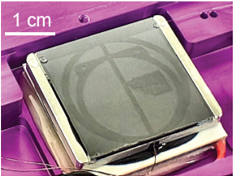
Caption: The new gyroscope combines several advanced technologies to achieve a high level of sensitivity. It also uses just milliwatts of optical power. The packaged chip is pictured.
Credit: Daniel J. Blumenthal, University of California, Santa Barbara
In the new device, the sensing portion of the chip is a ring-shaped optical circuit about 24 millimeters across. Two semiconductor lasers send light into the ring in opposite directions, where interactions between the light and the material produce two highly stable Brillouin laser signals that travel around the ring. The relatively large ring is important because optical gyroscopes become more sensitive as the area enclosed by the ring increases. When the chip is stationary, the two light signals behave the same way. When the chip rotates, however, the rotation causes a tiny difference between their frequencies. The chip detects that difference and uses it to determine how fast it is rotating. The silicon nitride ring in this device had an intrinsic Q factor of more than 163 million. This allowed the resonator to provide extremely selective filtering, isolating a 2 MHz bandwidth from a 200 THz optical signal, while being able to hold onto photons for nearly 100 nanoseconds. Measuring extremely slow rotation To test the new device, the researchers put the packaged chip, which measured just a few centimeters across, on a small piezoelectric rotation stage and moved it back and forth at a set of testing frequencies. They used a separate optical interferometer to measure the actual motion and compared that with the gyroscope reading.
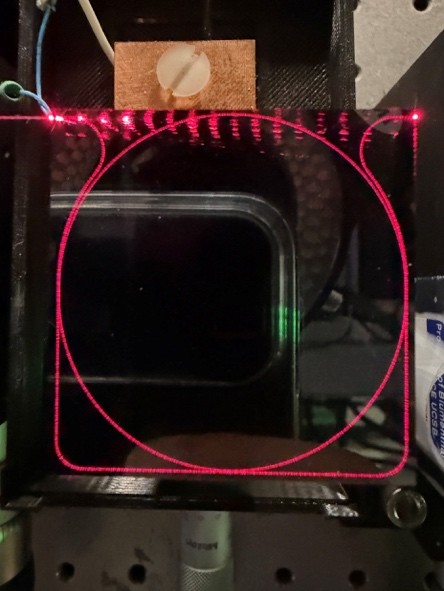
Caption: The optical ring-laser gyroscope uses a relatively large ring (pictured), which helped improve sensitivity.
Credit:Daniel J. Blumenthal, University of California, Santa Barbara
The gyroscope’s response to the movement was linear, and the researchers were able to measure rotations as small as 37 degrees per hour. This showed that combining CMOS-compatible technology and very high optical Q as well as very large optical resonators can be used to make a high-sensitivity optical gyroscope. The researchers are now working to improve the device’s material and resonator so that less unwanted pump light scatters backward, which should make the measurement more stable. They plan to then package the system into one compact unit for testing outside the laboratory. Finally, integrating all lasers, photodetectors and other gyro components on the same chip using the full photonic integration process will enable a complete laser optical gyroscope on a chip. Paper: J. Ge, Q.-X. Ji, M. Song, K. Liu, C. Zhong, H. Yan, J.-Y. Liu, P. Liu, Y. Yu, R. Chawla, S. Krzyzewski, D. J. Blumenthal, K. Vahala., “Integrated microresonator Brillouin gyroscope demonstrating 37 deg/h rotation measurements,” Opt. Lett., 51, 5854-5857 (2026). DOI: 10.1364/OL.589952
About Optica Publishing Group
Optica Publishing Group is a division of the society, Optica, Advancing Optics and Photonics Worldwide. It publishes the largest collection of peer-reviewed and most-cited content in optics and photonics, including 19 prestigious journals, the society’s flagship member magazine, and papers and videos from over 1200 conferences. With over 520,000 journal articles, conference papers and videos to search, discover and access, its publications portfolio represents the full range of research in the field from around the globe.
About Optics Letters
Optics Letters offers rapid dissemination of new results in all areas of optical science with short, original, peer-reviewed communications. Optics Letters accepts papers that are noteworthy to a substantial part of the optics community. Published by Optica Publishing Group and led by Editor-in-Chief Carsten Rockstuhl, Karlsruher Institut für Technologie, Germany. For more information, visit Optics Letters.
Media Contact
