Enrique Castro-Camus
Centro de Investigaciones en Optica AC, MexicoFor novel applications of terahertz techniques in multiple fields, particularly medical diagnostics, plant biology, and cultural heritage conservation
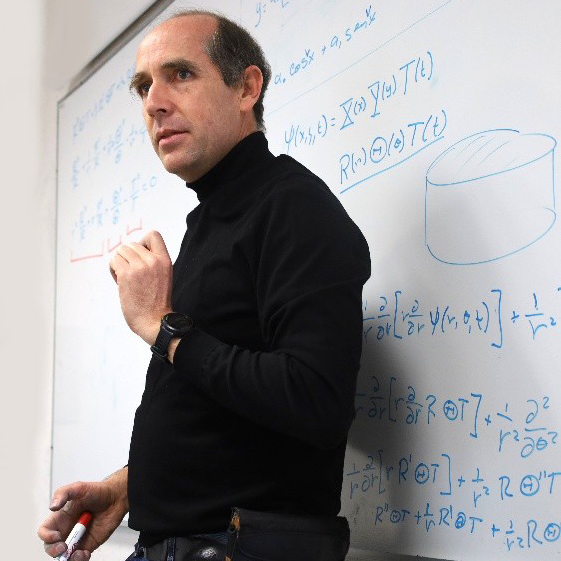
Enrique Castro-Camus has contributed to a variety of fascinating research areas, but the one he’s most proud of could have a profound impact on global health. He shares that roughly 10% of the global population has or will have diabetes. A somewhat common progression of that disease is Diabetic Foot Syndrome, which often requires amputation. Currently, there is no early way to determine if a diabetic person will develop the condition, but Enrique’s team is working to change that. Using terahertz sensing, they can create a map of a person’s skin to monitor hydration, a common indicator of the likelihood of wound development. However, this is challenging for several reasons. One in particular is that, for the results to be most useful, his team needs to monitor the patients over a span of 5 to 6 years, which is a stretch for many funding opportunities. He notes that this important research cannot be rushed, but the early results have already been rewarding. Another application Enrique is currently exploring is the preservation of cultural heritage. Using terahertz radiation, the team can look beneath the layers of paintings or other culturally significant objects to see what lies beneath. One particularly important restoration project Enrique worked on was the Kiosk of Guadalajara, Mexico, in the Plaza de Armas. He shares, “It’s a huge object in the middle of the city center. We had to work overnight on scaffolds with our delicate lab equipment, all outdoors and running on generator power. These were extremely rare conditions, but it was great fun.” A third application for Enrique’s research is connected to agriculture. His team uses terahertz to detect and understand drought stress in plants and has begun to grow beyond a basic research collaboration. A potential outcome they’re working towards is reducing water consumption in crops, which could ultimately lead to better, more drought-resistant varieties.
Enrique’s group was among the first to conduct terahertz research in his organization. They built the first spectrometer here, allowing the first experimental research. After a few years, the Consejo Nacional de Ciencia y Tecnología (Conacyt, now SECIHTI) launched an initiative to create national labs. These were larger, well-equipped labs consisting of researchers from two to three institutions with a specific topical focus. Enrique teamed up with a group at the Universidad Autónoma de San Luis Potosí to create the National Lab of Terahertz Technology in 2015. The formation of this national lab enabled the cutting-edge research that Enrique does today.
Enrique is passionate about science communication. Throughout his career, he has worked to communicate the importance of scientific research to the general public through many different avenues. He writes articles for local newspapers to share interesting updates with the community, gives interviews on various programs, and used to host a weekly radio program. His primary outreach now is a talk he gives to middle and high school students about the opportunities a career in science can enable.
Not only does Enrique serve the greater public, but he also serves the scientific community and is involved with Optica and other professional societies. One of his first professional activities as a scientist was attending Frontiers in Optics in 2001, where he gave a talk. He is also involved in the International Society for Infrared and Millimeter Waves, a more specialized society for his field of research. With them, he organized the International Conference on Millimeter and Terahertz Waves in 2017, their largest meeting. Looking to the future, he hopes to raise the visibility of Mexican researchers within the worldwide community.
Photo Credit: Juvenal Iván Hernández Guevara
Profile Written by Samantha Hornback
