Johannes Schwider
About Optica
In Memoriam: Johannes Schwider, 1938-2026
03 May 2026
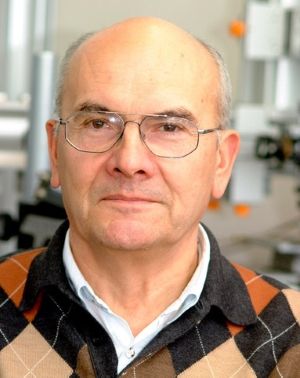 Professor Johannes Schwider, a researcher whose career spanned more than six decades of optical metrology and an Optica member for 30 years, passed away on 03 May 2026 at the age of 87. In his life, he experienced all facets of the recent history of Germany, which reflected the more global East-West conflict.
After studying physics at the Technical University of Dresden, 1956-1961, with a diploma thesis in spectroscopy, he began his scientific career in January 1962 at the Institute for Optics and Spectroscopy of the Academy of Sciences in East Berlin (Berlin-Adlershof), where he joined the Wave-Optics Department (Professors G. Schulz and R. Ritschl) and defended his PhD in 1966. He, his colleagues and coworkers produced results of international standing in wavefront testing, starting from absolute plane surfaces and moving to spheres, aspheres, and finally “free forms.” His 1983 work with his colleagues of the time on error sources in digital wavefront measurement interferometry is a landmark on the subject. He is likewise internationally recognized for his study of optimal use of phase shifting interferometry. Johannes and his coworkers often published their results in Optica journals such as Applied Optics, which is remarkable for two reasons: (1) it underlines the quality of their research and (2) it shows that apparently the Export Administration Regulations at the time did not prevent this.
In 1987, given the general political and Johannes’ own personal circumstances in the German Democratic Republic, Johannes’ wife Heidi urged him not to return from a very rare visit to West Germany. His wife had somewhat underestimated what this meant for herself and their teenage son. Finally, after serious hardship, they joined Johannes shortly before the Berlin Wall fell anyway. Back in 1987, Johannes had contacted Professor Adolf W. Lohmann at the University of Erlangen-Nuremberg, and after a transition period, he received an academic position there in Applied Optics heading a research group on optical measurement and optical design, working on interferometric surface metrology with sub-nanometer sensitivity until well after his official retirement. His outstanding optics research helped greatly to establish the Max Planck Institute for the Science of Light at Erlangen, with which he had been associated ever since.
In 2013, Optica (then The Optical Society) invited Johannes to contribute an article to the fiftieth anniversary issue of Applied Optics — a recognition of the sustained international impact of his contributions to optical testing and wavefront metrology.
His move from East to West in 1987 was not his first escape. He was born in Gleiwitz, now Gliwice, located in Upper Silesia. Close to the end of World War II, in January 1945, the six-year-old Johannes had a very serious case of pneumonia and was close to dying. At that time the front was moving in from the East, and civilians had started to flee for safety. At the train station, his mother convinced a medical doctor to give the boy a new drug, penicillin, that had not yet been approved for the general public, and that he was only entitled to give to sick soldiers. This shot would save Johannes’ life. He was then admitted on the last train out of Gleiwitz, a medical Red Cross train to Berlin for those sick and wounded. But that left him alone somewhere in Berlin. Before he left Gleiwitz, his father had instructed Johannes, that in Berlin, should he survive, he should go to the nearest cinema every night, and he promised to find him. After a high-risk trip from Gleiwitz to Berlin, his father managed to find the local cinema where Johannes was waiting for him, and thus, kept his promise. Both this escape as well as the one in 1987 were traumatic.
Johannes Schwider was a quietly determined scientist who worked with ingenuity and precision, caring for his group for a long time under circumstances that would have discouraged many. He is survived by his son, Peter Schwider. He and the optics community mourn his loss.
Obituary prepared by Pierre Chavel, Gerd Leuchs, and Norbert Lindlein
