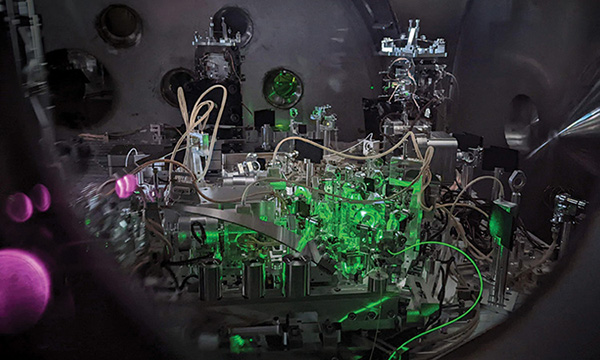
| V. de Schwanberg / Science Photo Library |
|
This year marks the 100th anniversary of the initial development of quantum mechanics by Werner Heisenberg, Max Born, and Jordan Pascual. In recognition of this seminal milestone, as well as of the continued growth and importance of quantum science, UNESCO has declared 2025 to be the International Year of Quantum Science and Technology (IYQ). A feature article in the January issue of Optica’s magazine Optics & Photonics News (OPN) takes a closer look at how IYQ came about, what its organizers hope to achieve, and some of the events and activities planned around the world to celebrate quantum science and technology.
|
|
|
|
|
|
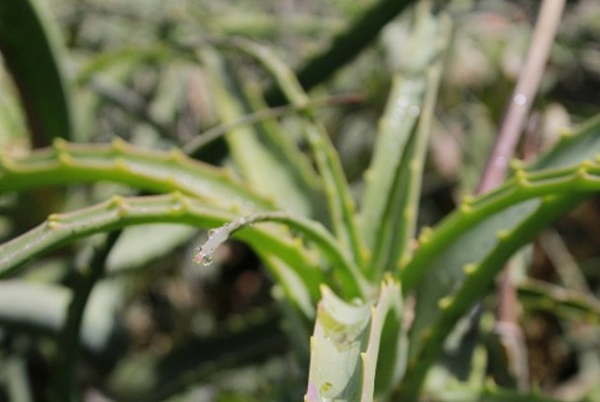
| The researchers found that agave leaves have an inner core that remains highly hydrated while the outer layer acts as a protective barrier to reduce water loss. |
| In the Optica Publishing Group journal Applied Optics, the researchers show that terahertz spectroscopy is a powerful tool for studying plants without causing any damage. Using this approach, they found that agave plants survive in dry environments by storing water in a specialized leaf structure and that its fructans act like molecular sponges to retain moisture.ody: |
|
|
|
|
|
| |
|
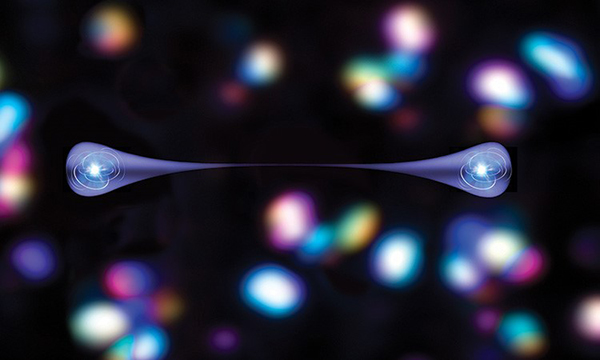
Reducing noise can enhance the performance of sensitive detectors but runs up against limits imposed by the probabilistic nature of quantum mechanics. Heisenberg’s principle stipulates a minimum combined uncertainty when measuring the amplitude and phase “quadratures” of an electromagnetic wave. In the case of a laser beam, noise is spread equally between the two, yielding a circle when plotting the values of one against the other. By squeezing the circle so it becomes an ellipse, noise can be traded—increasing uncertainty in one quadrature while reducing it in the other, creating a squeezed state of light.
A feature article in the May issue of Optica’s magazine Optics & Photonics News (OPN) looks at the latest in squeezed light research, including the prospect for compact, high-quality squeezing sources that could enable sensors with unprecedented precision, new probes of fundamental physics and universal quantum computers.
|
|
|
|
|
|
| |
|
In a new study published in Optica, researchers conducted the largest coordinated comparison of optical clocks to date across six countries, using both satellite and optical fiber links. The study marks a major step toward redefining the second using highly precise optical clocks, which are now 100 times more accurate than cesium clocks.
|
|
|
|
|
|
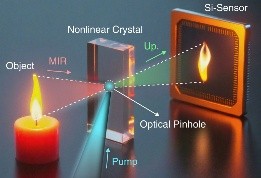
| Researchers use laser light to form a tiny “optical pinhole” inside a nonlinear crystal, which also turns the infrared image into a visible image that a traditional silicon-based camera sensor can detect. With this setup, the researchers captured clear, wide-depth images without using any lenses, even in very low light. |
| In a recent article from Optica, researchers describe how they used pinhole imaging to create a high-performance mid-infrared imaging system without lenses. This approach has the potential to enhance night-time safety, industrial quality control, and environmental monitoring, while making infrared imaging systems more affordable, portable, and energy efficient in the long run. |
|
|
|
|
|
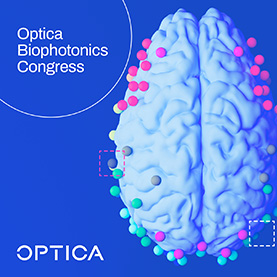 |
| Final Weeks to Submit |
| Submit to the Optica Biophotonics Congress and share advances in imaging, drug delivery and AI-powered biomedical analysis. Accepted papers will be published and indexed worldwide. |
|
|
|
|
|
 |
| Join Us in Los Angeles |
| Register for OFC 2026, 15–19 March 2026 with exhibition 17–19 March. Hear plenary speakers from Coherent, Nvidia and TESAT and explore 700+ exhibitors across optical networking and communications. |
|
|
|
|
|
| |
|
|

![[logo] Optica](https://opticaorg-dev-cac7d2csctagc8bm.z01.azurefd.net/$web/optica/media/email/footer/footer_email_optica-descriptor-horizontal-reverse.png)
![[icon] Twitter](https://opticaorg-dev-cac7d2csctagc8bm.z01.azurefd.net/$web/optica/media/email/footer/icon_twitter.png)
![[icon] Facebook](https://opticaorg-dev-cac7d2csctagc8bm.z01.azurefd.net/$web/optica/media/email/footer/icon_facebook.png)
![[icon] LinkedIn](https://opticaorg-dev-cac7d2csctagc8bm.z01.azurefd.net/$web/optica/media/email/footer/icon_linkedin.png)