Senior Member Programs
Membership
Senior Member Spotlight:
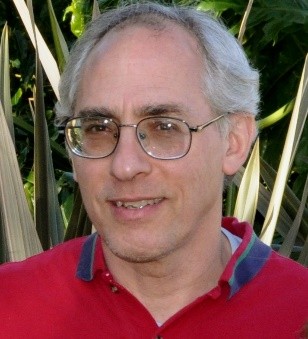
Meet Zachary Levine, this month’s featured Senior Optica Member Spotlight.
Q: What first sparked your interest in optics and laser science?
A: I had an opportunity to study with Prof. Anthony Garito at the University of Pennsylvania on highly efficient second-harmonic generation. The whole concept of shifting frequencies was a kind of “wow” moment for me. Although I never completed the experimental project and became a theorist instead, about 10 years later we (Douglas Allan and I) were able to accurately calculate nonlinear optical coefficients in solids using density functional theory.
Q: Can you share a defining moment or project that set the direction of your career?
A: Toward the end of coursework in graduate school, we were studying second quantization and many-body theory. It seemed that the whole thing depended on interacting first quantized matrix elements, which, in 1980, we themselves not understood. I decided to concentrate on these. Another key influence was the thesis work of Andrew Zangwill with whom I shared the thesis advisor Paul Soven at the University of Pennsylvania. I extended the Zangwill-Soven time-dependent density functional theory from atoms to molecules. (Later this was renamed adiabatic local-density functional theory. It has the same equations!) The time-dependent local fields represented a one-electron approach to a problem formerly treated with many-body techniques. A few years later, in calculating the dielectric constant of silicon, we (Doug Allan and I) introduced the “scissors operator” as a quantitative expression. (The term had been introduced a few years earlier informally.) Our 1989 PRL has over 500 citations, indicating it became a building block for the next generation or two of optical response calculations.
Q: What has been the most rewarding phase of your career so far, and why?
A: Around 2000, the semiconductor industry was developing 157 nm lenses made out of calcium fluoride. In collaboration with Eric Shirley and John Burnett, we showed that it was not possible to meet the optical isotropy requirements of the industry due to the crystal structure and a beyond-dipole approximation interaction. This work was an extension of the nonlinear optical calculations I had done previously. The semiconductor industry ultimately abandoned 157 nm lithography because of our work and instead adopted 193 nm immersion lithography. The implementation of 193 nm lithography needed to work around the optical anisotropy that we pointed out. The project was written up in the semi-popular press many times, including in Science and Feskurperphysik which described the work as “Optical anisopy in crystals with cubic symmetry—an effect of fundamental research with industrial relevance” (translated from German). This is the dream: to affect the economy based on a quantum mechanical calculation (with experimental confirmation from our colleague John Burnett).
Q: How have you contributed to mentoring or supporting the next generation of optical scientists and engineers?
A: I have mentored numerous undergraduate and graduate students through research projects, nanoHUB tool development, and collaborations with national laboratories. Many of them have co-authored journal papers, presented at major conferences, and contributed to open-access educational tools. I also integrate research-based learning into my Computational Methods for Electromagnetics course, where students gain hands-on experience with modern simulation methods. My goal is to help the next generation of optical scientists and engineers develop both strong technical foundations and independent research skills.
Q: Which of your professional accomplishments are you most proud of?
A: The calculation of optical rotatory power was an extension of the work in nonlinear optics discussed above. Not only did our group perform the calculation (with Hua Zhong and John Wilkins), but we were the first to formulate the theory of optical rotatory power in solids. There was a theory by Max Born suitable for molecules, but it could not be extended to solids because the derivation was tied to localizable units. Nevertheless, we developed the theory and performed accurate calculations. The implementation was relatively simple because the code developed to do nonlinear optics had, in effect, a language that could apply to any formula involving integrating various combinations of Green functions over the Brillouin zone.
Have someone in mind for a future feature? Submit your nomination for an upcoming Senior Member Spotlight. Send an email to smcalester@optica.org with Senior Member Spotlight Nominee in the subject line.
Senior Member Programs
Annual Receptions
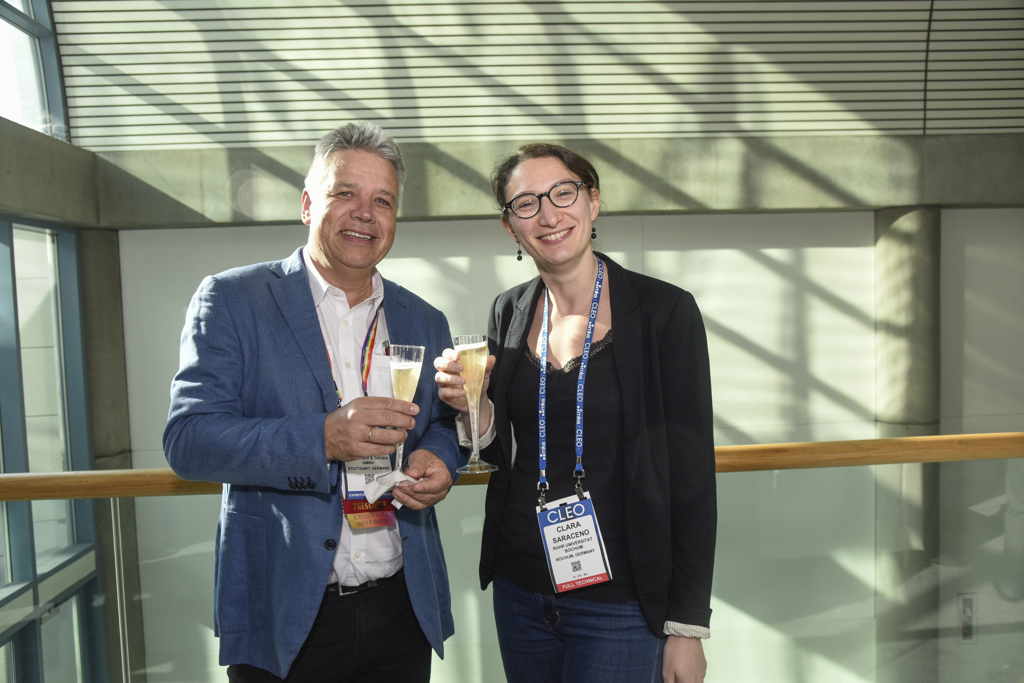
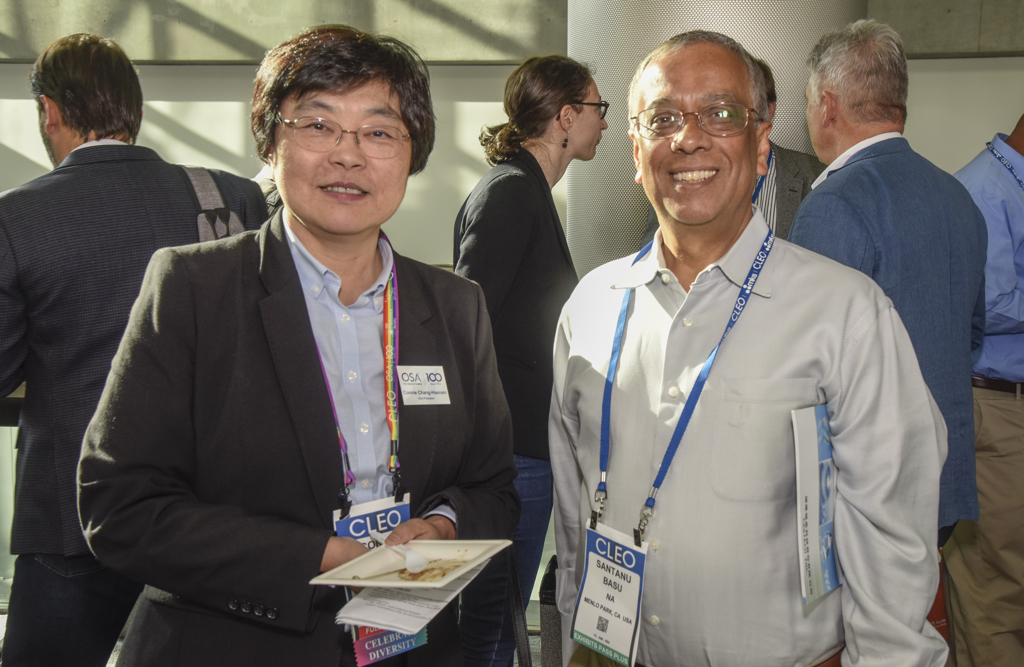
Each year, we gather to honor our Senior Members at the Frontiers in Optics + Laser Science APS/DLS Conference (FiO+LS). Join us at to celebrate our member's accomplishments and network with others across your field.
Frontiers in Optics + Laser Science APS/DLS Conference (FiO+LS)
View On-Demand Professional Development Programs
Mastering Impromtpu Speaking
Some of our most critical speaking situations happen when we are unprepared. The way in which we speak off the cuff is partly how our leadership skills will be measured. Impromptu speaking is a skill which we can build with practice and feedback. In this interactive training, you will learn a strategic framework for speaking clearly and concisely with no advanced preparation. You will receive instructor feedback by volunteering to answer questions using the strategic framework you just learned. You will retain the strategies by role-playing difficult and impromptu questions among peers in a breakout group. You will leave the session with more confidence and more tools to speak up in your most important professional settings.
Five Tips for Writing Winning Grant Proposals
To have a successful career in science, you must be able to convince strangers to give you enormous sums of money. However, competition for those dollars is fierce and unfortunately, many scientists miss the mark writing research proposals. Dr. Damon Diehl is determined to change that and make reviewers’ jobs more difficult by arming scientists and engineers with the tools they need to craft compelling grant proposals. This webinar teaches how to identify organizations that WANT to give you money out of the thousands of grants that are available so that you can prioritize and focus your efforts on those with the highest return. This program is intended for Optica Senior Members Only.
