2026 Paul F. Forman Team Engineering Excellence Award Winner
Get Involved
TOPTICLOCK Team Named the 2026 Paul F. Forman Team Engineering Excellence Award Recipient
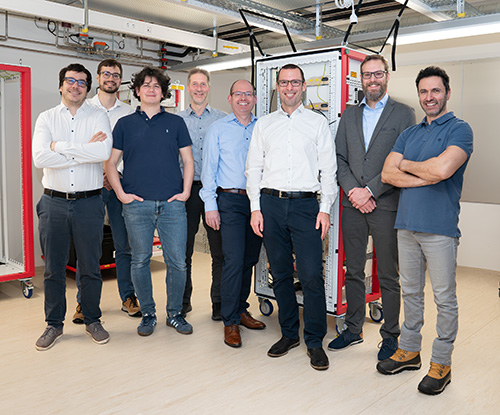
Optica is pleased to announce that TOPTICLOCK Team, Germany, has received the 2026 Paul F. Forman Team Engineering Excellence Award. The team, with representatives from the German National Metrology Institute (Physikalisch-Technische Bundesanstalt (PTB)) and TOPTICA Photonics SE, is recognized for the development of a commercial single-ion optical clock by combining ultra-low-noise photonics and quantum technology providing an unprecedented level of accuracy in an industrial form factor.
The Paul F. Forman Team Engineering Excellence Award was established in 1989 and named in remembrance of Paul F. Forman, who helped raise visibility for the optical engineering field in 2007. The award recognizes technical achievements such as product engineering, process, software and patent development, as well as contributions to society such as engineering education, publication and management, and public appreciation of optical engineering. It is endowed by Zygo Corporation, Canon Inc, Optical Research Associates (now the Optical Solutions Group at Synopsys), Cambridge Research & Instrumentation, Inc, and individual contributors, Barbara Marks-Forman, Gary and Carolyn Bjorklund and G. Michael Morris.
The TOPTICA Optical Ion Clock Team (TOPTICLOCK Team) developed a commercial single-ion optical quantum clock by combining ultra-low-noise photonics and quantum technology, providing an unprecedented level of accuracy in an industrial form factor. The team was formed to transfer technology and know-how from the German National Metrology Institute (Physikalisch-Technische Bundesanstalt (PTB)) to TOPTICA Photonics SE. The PTB-TOPTICA cooperation builds on the collaborative research project “opticlock”, co-coordinated by TOPTICA and PTB, in which a research demonstrator of a rack-integrated optical frequency standard was realized by ten scientific and industrial partners.
The TOPTICLOCK Team then moved forward towards a commercial product and industrialized the clock. The team consists of the scientific advisor and optical clock expert Nils Huntemann from PTB and TOPTICA employees with backgrounds in scientific quantum technologies and engineering. Within only three years, the team developed, delivered, and qualified the commercial optical quantum clock TOPTICLOCK, and set it into operation at a lead customer site. With its relative stability and accuracy on the order of 10-17, it outperforms commercial optical clocks based on thermal vapors by approximately two orders of magnitude. Such a performance in an industrial form factor marks an important milestone towards the redefinition of the SI-second based on optical clocks. Other applications are time scales and time services, network synchronization, ground reference for satellite navigation, and fundamental scientific research.
The engineering challenges to transfer a laboratory setup, that can only be operated by experienced scientists, into an industrial footprint for general users – while maintaining the world-class performance – are enormous. Optical clocks consist of a local oscillator, a reference and an optical frequency comb as clockwork. TOPTICLOCK’s local oscillator is a clock laser system (CLS) with a linewidth below 1 Hz. This is achieved by controlling the length of an optical cavity to below 1 fm, smaller than the size of an atomic nucleus, and transferring it into frequency stability of a diode laser. For long-term and absolute frequency stability, the CLS is disciplined to the E2 optical clock transition of a single trapped and laser-cooled 171Yb+ ion at 436 nm via high-resolution spectroscopy with the CLS. Four additional lasers from 370 nm to 935 nm are needed to prepare, laser-cool and detect the quantum state of the Yb+ ion. The lasers must be power- and frequency-stabilized, frequency-modulated, frequency-shifted, optically split and combined, and directed to hit the trapped ion, which itself sits in an ultra-high vacuum chamber within an electromagnetic trap. In order to profit from the potential advantage of the quantum state control of the ion, its environment like temperature-induced black-body radiation, residual magnetic fields, light intensities, varying electric fields, etc. must be controlled and/or measured precisely. A user-friendly industrial system also requires comprehensive software to operate and monitor the system. All subsystems of the optical ion clock are placed inside two transportable, industrial 19” rack compartments. This required high-level optical, mechanical, thermal, electric, control, software, and systems engineering.
TOPTICA Photonics SE
• Dr. Axel Friedenauer, Physicist, Project Leader, 2022 to present
• Dr. Pierre Thoumany, Physicist, Team Member, 2023 to present
• Dr. Christoph Tresp, Physicist, Team Member, 2024 to present
• Rami Al Kamand, Mechanical Engineer, Team Member, 2022 to present
• Dr. Daniel Heinrich, Physicist, Team Member, 2024 to present
• Dr. Dario Lago-Rivera, Physicist, Team Member, 2025 to present
• Dr. Stephan Ritter, Physicist, Team Leader, 2022 to present
• Dr. Jürgen Stuhler, Physicist, Principal Investigator, 2022 to present
Physikalisch-Technische Bundesanstalt (PTB, German National Metrology Institute)
• Dr. Nils Huntemann, Physicist, Scientific Advisor, 2022 to present
About Optica
Optica, Advancing Optics and Photonics Worldwide, is the society dedicated to promoting the generation, application, archiving and dissemination of knowledge in the field. Founded in 1916, it is the leading organization for scientists, engineers, business professionals, students and others interested in the science of light. Optica's renowned publications, meetings, online resources and in-person activities fuel discoveries, shape real-life applications and accelerate scientific, technical and educational achievement.
