May the Fourth
History
A long time ago...in a galaxy far, far away...
Optica was founded. Since then, optics research has proven that many technologies used in science fiction are actually possible. Tractor beams? Check. Lasers? Check. Holograms? Check. The search for other planets? Check.
We put together some of our favorite articles for your viewing pleasure.
May the Fourth....and F = m * a be with you.

RESEARCH NEWS
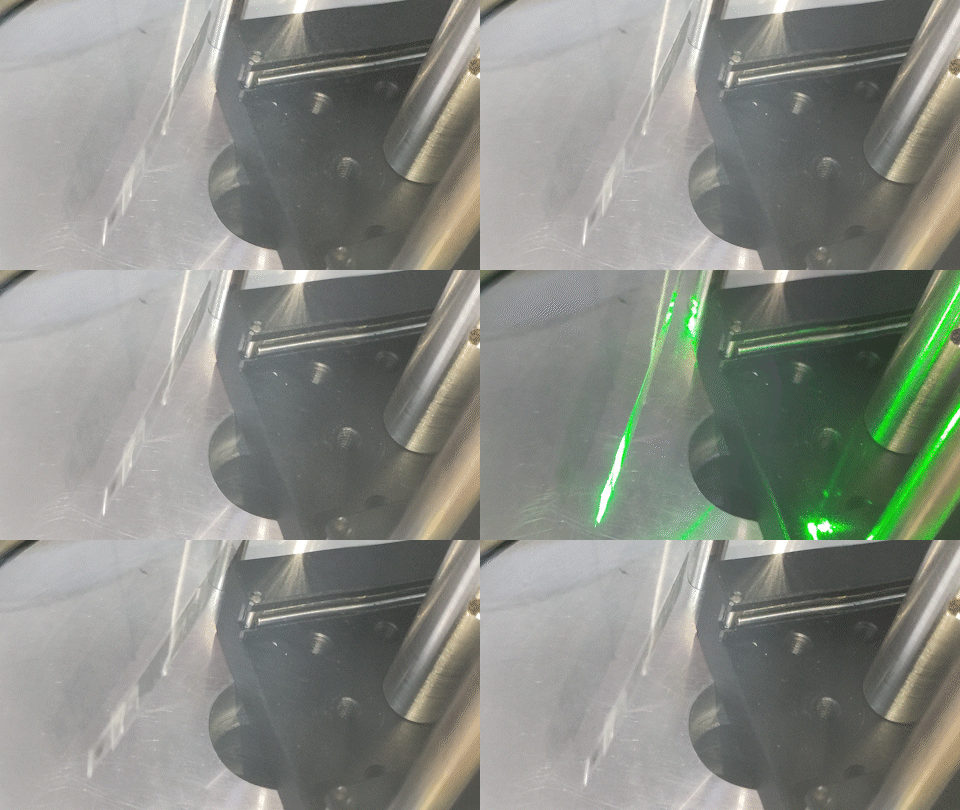
A holographic lens for the search of exoplanets
A lightweight, flexible lens, developed by RPI scientists for potential next-generation space missions, can either focus light or disperse it, separating it into its constituent colors for high-resolution spectroscopy of exoplanets.
Such instruments could be used to directly observe extrasolar planets, vastly improving upon traditional techniques that detect exoplanets based only on light coming from the star they orbit.
RESEARCH NEWS
Lasers that pull macroscopic objects
Researchers have enabled laser pulling beyond the microscopic scale, which could be useful for scientific and space applications (not beaming cows into a UFO).
To do this, they developed a graphene-SiO2 composite structure that gets hot on the side facing away from the laser. This causes gas molecules on the back to receive more energy, pushing the object toward the light source.

RESEARCH NEWS
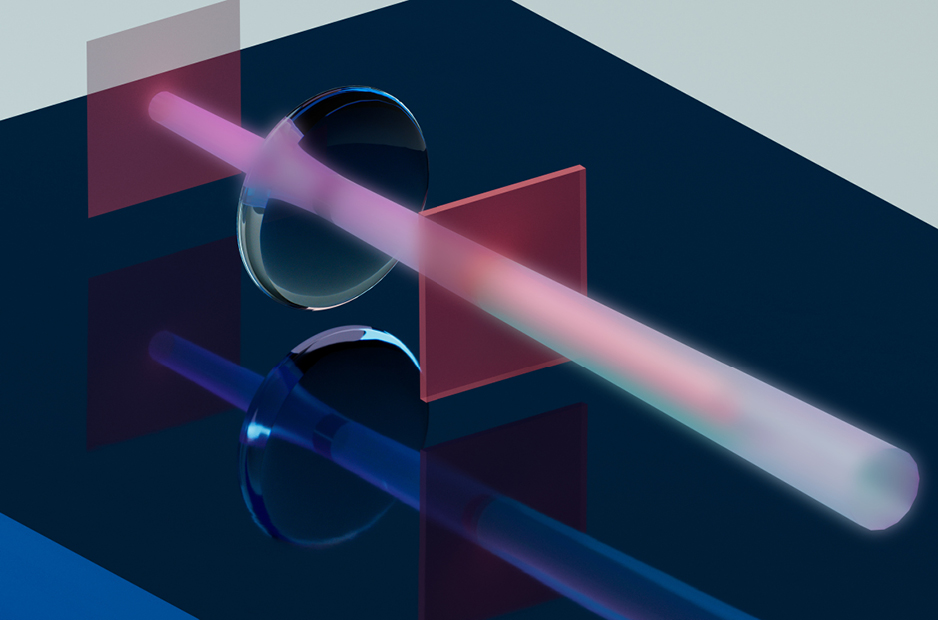
Seeing deeper into the cosmos with gravitational-wave detectors
Quantum noise has become a limiting noise source when measuring gravitational waves.
By tuning their system to respond at a desired frequency, researchers reduced this noise by using an optical spring to track a signal coming from a compact binary system.
In the future, this binary system could be two black holes orbiting each other – within our galaxy or beyond.
EVENTS
Working with lasers?
Your laser research is more than science fiction.
Showcase everything from research in plasma sources, biological imaging, attosecond science and more at the Optica Laser Congress and Exhibition.
11 - 15 October 2026
Radisson Blu Hotel Lietuva
Vilnius, LITHUANIA

RESEARCH NEWS
“To boldly go …” with quantum information
A team at the quantum computing company Quantinuum has reportedly achieved the high-fidelity, fault-tolerant teleportation of a quantum state encoded in a so-called logical qubit.
The advance could one day enable the scaling up of trapped-ion platforms into universal, fault-tolerant quantum computers.

RESEARCH NEWS
"Freezing time" for the continuous monitoring of components
Based on a single-pixel detector using synchronized illumination, this imaging system can enable the continuous monitoring of components like turbine and jet engine blades, which could help detect early signs of wear or damage.
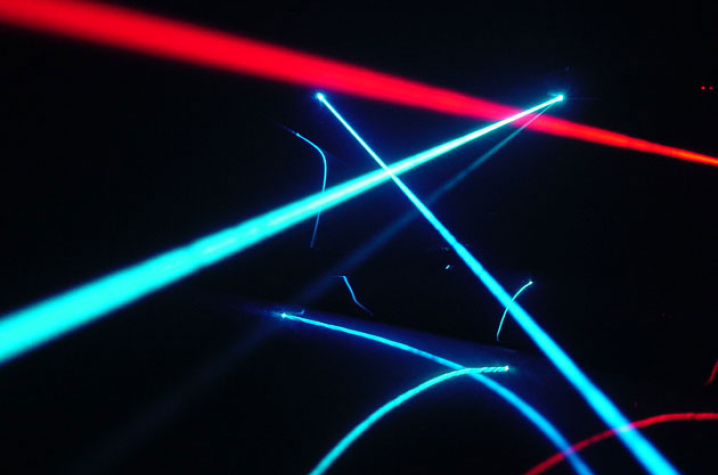
IMAGE OF THE WEEK
Laser Duel
Fun with an Argon-ion and a He-Ne laser. Jeff Keyzer from San Francisco, Calif., U.S.A.

IMAGE OF THE WEEK
Spherical Aberrations
A hemispherical lens highlights spherical aberrations. A red laser and a green laser, together with a pair of diffraction gratings, form an array of horizontal and vertical rays. The ray caustic can clearly be seen to the right of the lens.
—Chris Summitt College of Optical Sciences, University of Arizona, USA
