International Coffee Day
History
Do you smell that? It's coffee. The coffee we serve at Optica meetings, coffee as a subject of research, coffee in your coffee, and, we hope, coffee in an Opticat mug.
Let's celebrate International Coffee Day by finding all of the wonderful ways in which a little caffeine can go a long way.
Research News
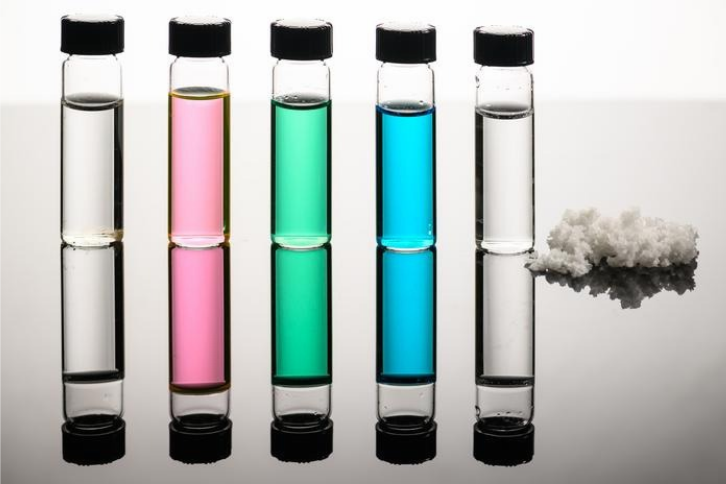
Solar-powered desalination - without the drawbacks
If you drop coffee on a surface, eventually the water evaporates, and there's a ring left at the outer edge that contains concentrated coffee particles.
With this principle, researchers created a solar-powered desalination device that removes salts from ocean water and leaves solid salts that contain valuable minerals such as lithium
[Image: J. Adam Fenster, University of Rochester]
OPTICA EVENTS
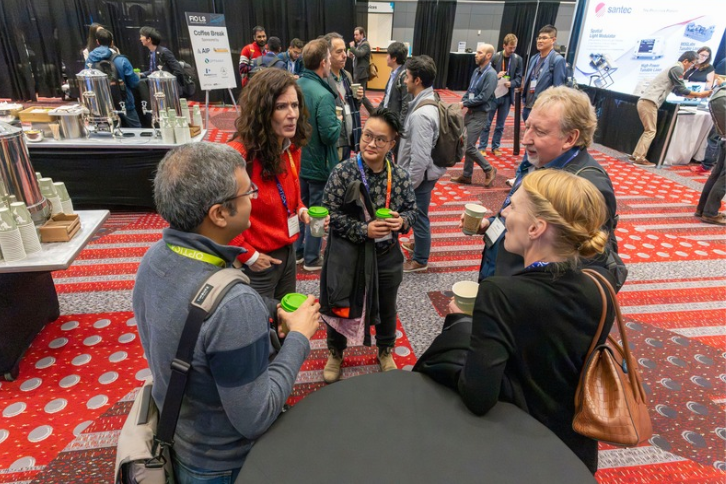
More than 7,500 liters served.
In one year, Optica Conferences and Congresses will serve more than 2,000 gallons/7,570 liters of coffee to event attendees!
Discovering lab collaborations, making friends and getting a new perspective to solve that stubborn research question can all be found in one of those "coffee talks."
Find an Optica Event, we have plenty of coffee breaks.
(Strong cups of coffee will be ready for you.)
Optica Publishing Group
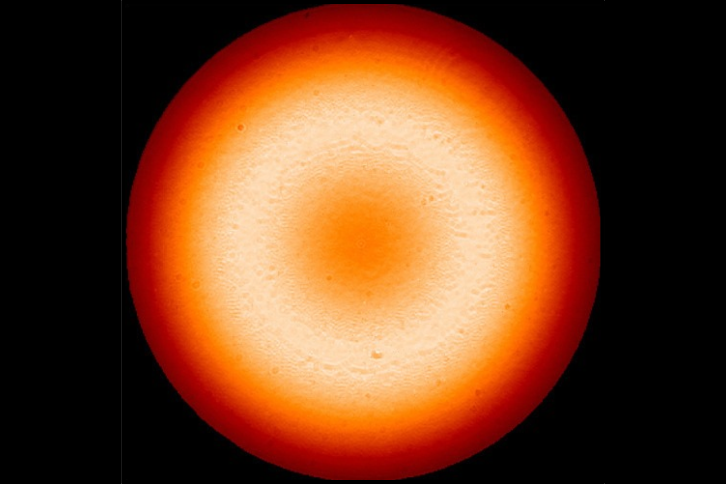
COFFEE for wave-front control
Coffee is a beverage we drink in the morning (or afternoon, or evening; we don't judge).
COFFEE is a focal plane wave-front sensing method that can estimate low- and high-order aberrations with nanometric precision for any coronagraphic device
Based on a Bayesian approach, it estimates the quasi-static aberrations from two focal plane images recorded from the scientific camera itself.
Read more about how COFFEE estimates low- and high-order aberrations with nanometric precision for any coronagraphic device in this Optics Express article.

Careers
From Coffee Break to PhD
Andrea Pacheco, 2025 Optica Ambassador, found solutions in her PhD program over informal coffee talks. During these breaks, Pacheco learned from doctors, scientists and engineers across fields very different than her own.
Interdisciplinarity is a mindset that Pacheco has taken throughout her work as an Optica Ambassador, supporting students and early-career researchers so they can become the best version of themselves.
In this conversation with OPN, Pacheco discussed her inspiration for becoming a physicist, the importance of outreach, how mentorship shaped her career and becoming a parent as an early-career academic.
Optica Publishing Group
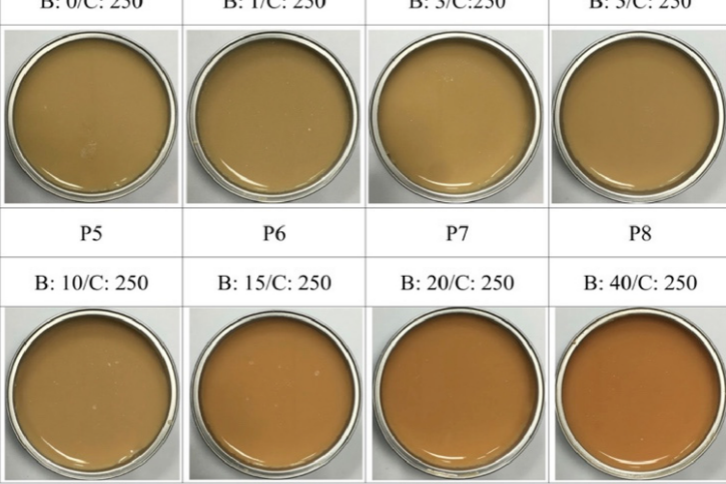
A photon diffusion theory-based method to screen neonatal jaundice
Just as we can drink coffee for a caffeine boost, we can also use it as a medium for scientific discovery.
In the development of a noninvasive method to screen for neonatal jaundice, researchers mixed water with coffee powder to mimic skin melanin.
Their results indicated that photon diffusion theory could improve the core algorithm of modern bilirubinometers and enhance their applicability.
OPTICA PUBLISHING GROUP
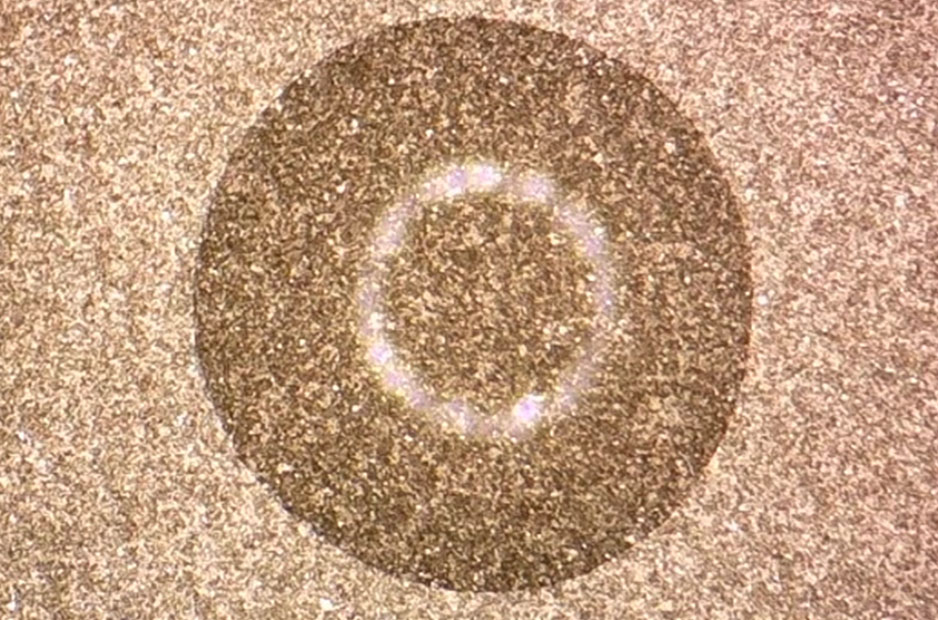
A drop of coffee? No, that's the coffee-ring effect!
The coffee-ring effect (CRE) refers to the phenomenon of how, when a turbid drop dries on a solid surface, its suspended particulates will be deposited in a ring-like pattern.
Researchers leveraged CRE to obtain the patterned deposition of nanoparticles on a titanium substrate, which could improve NP-printed circuit boards and site-specific delivery of drugs.

OPTICA PUBLISHING GROUP
Coffee is the second most traded commodity in the world.
That's why it's critical to detect micro-toxic elements in our daily cup.
This fast detection system precisely detects toxins in coffee and can check the purity and quality of food products.
OPTICA PUBLISHING GROUP
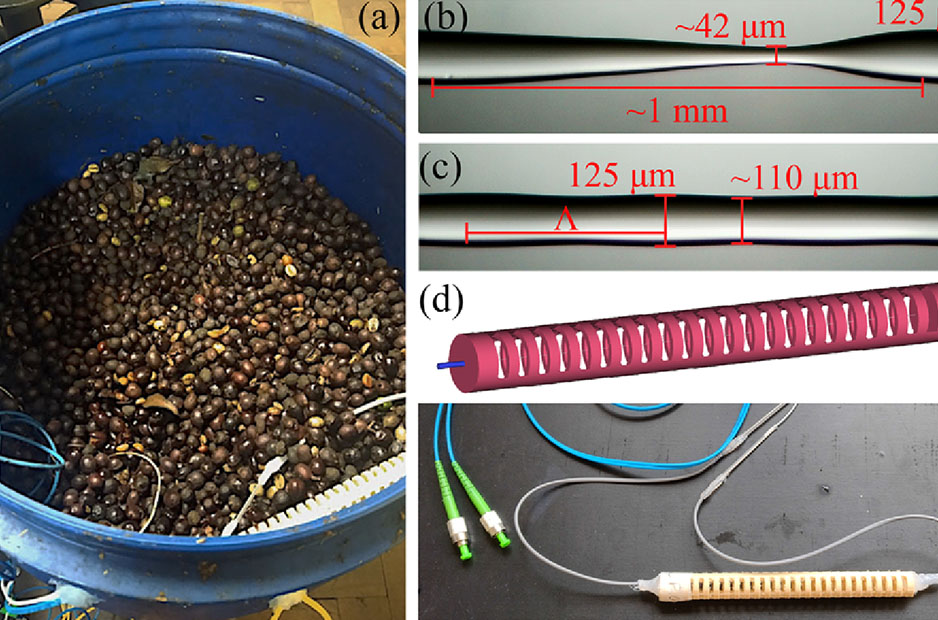
Coffee, aroma and optics that can smell.
The relationship between the bean fermentation and the coffee aroma profile is delicate and important, affecting coffee quality.
This in-fiber Mach–Zehnder interferometer functions as an optical "nose," capable of determining the variety of odors arising due to the yeast activity, and their classification to decide when to stop the fermentation process
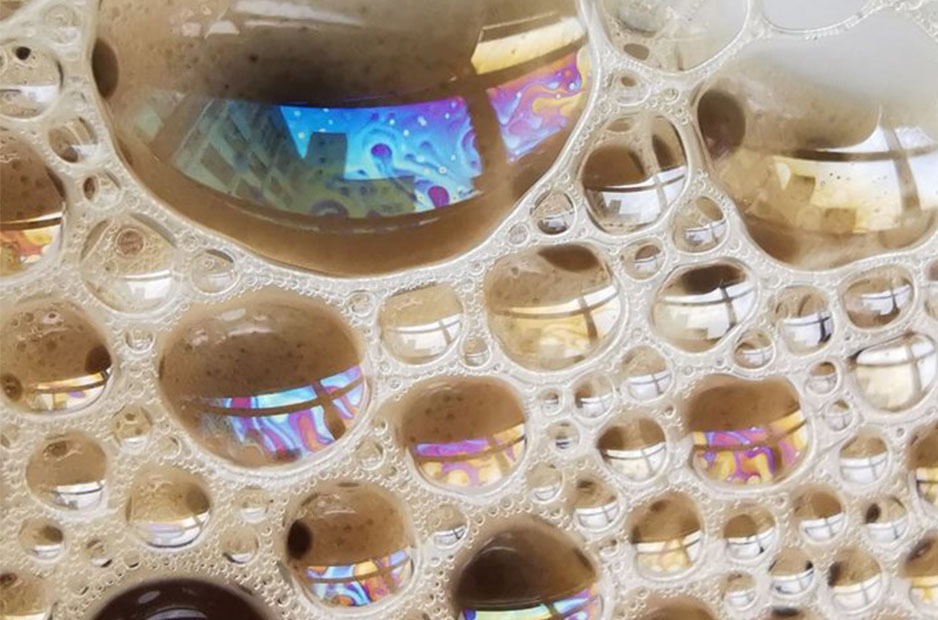
IMAGE OF THE WEEK
Coffee Interference
Images of the blue sky above a university building, reflected in coffee bubbles, are magically colored by destructive thin-film interference of the spectral parts of the daylight (complementary colors).
—Aliaksei Kobylinskiy, University of Applied Sciences Jena, Jena, Germany
RESEARCH NEWS
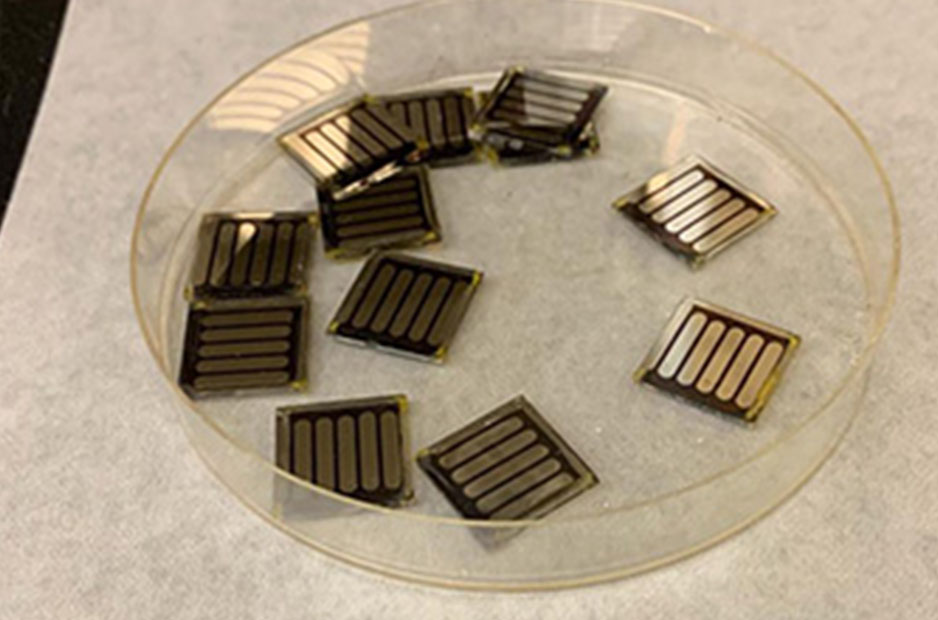
Yes, solar cells could use caffeine, too.
To help overcome roadblocks in their long-term stability, researchers recommend a novel way to boost both the efficiency and the long-term staying power of certain perovskite PVs: give the cells a jolt of caffeine.
