Jacquiline Romero
University of Queensland, AustraliaFor her seminal contributions to quantum structured light and her pioneering role in promoting quantum science in the Philippines.
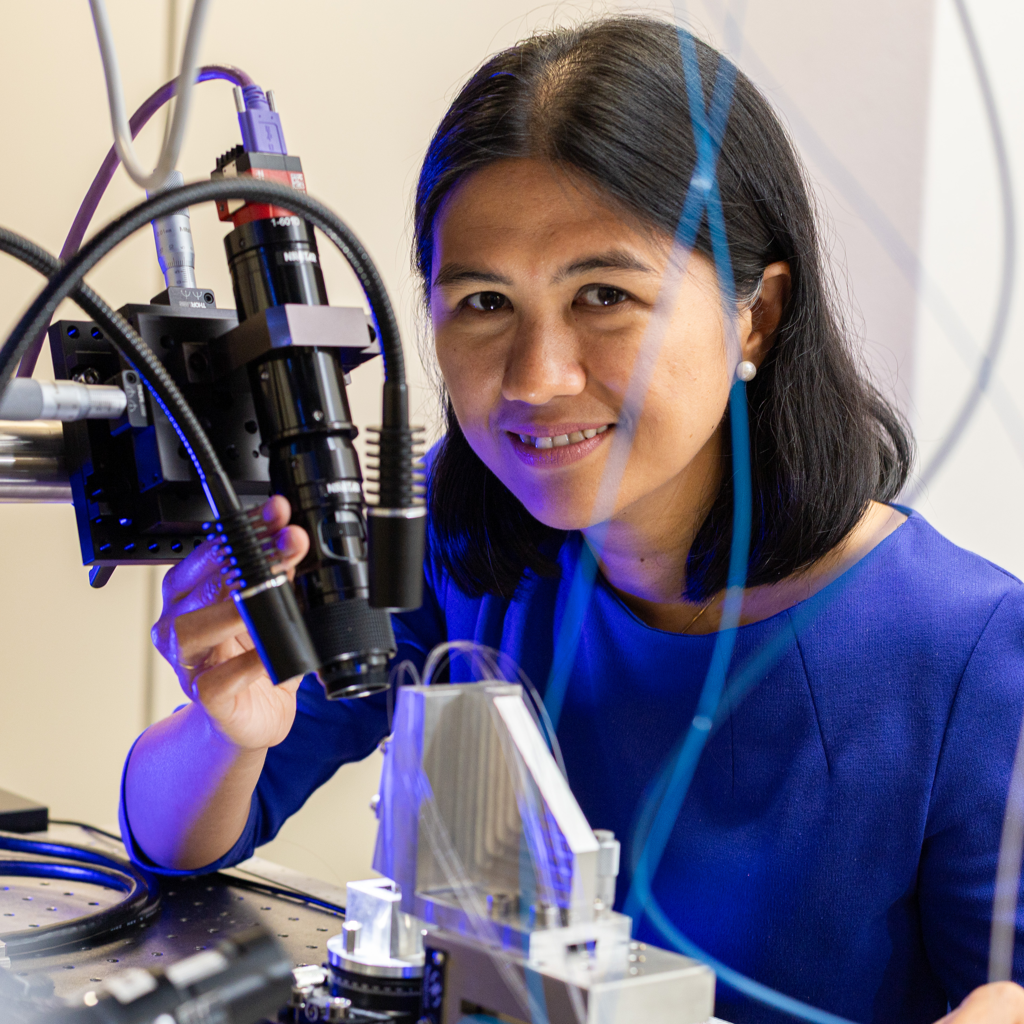
Jacquiline Romero (Jacqui or Jacq to her colleagues) is a physicist with a deep passion for optics and a strong commitment to making the field more inclusive through thoughtful leadership and mentorship. Throughout her career, she has been shaped by supportive and empowering mentors, whose influences continue to guide her own approach to leadership today.
She has been mentored by several Optica Fellows, starting in the Philippines where she trained under Caesar Saloma as an undergraduate. She later pursued her PhD with Miles Padgett and Steve Barnett in Scotland, before moving to Australia where she has been mentored by Andrew White and Halina Rubinsztein-Dunlop. In each stage, her mentors shared a defining quality: they actively supported and enabled those around them. Inspired by this example, Jacqui strives to foster the same culture, working to reshape perceptions of optics and broaden participation in physics.
As both an advisor and educator, she is dedicated to supporting undergraduate and graduate students, challenging the notion that physics is an elite discipline only for the gifted. She illustrates her philosophy with a sporting analogy: rather than building a team solely by recruiting already elite players, she believes in welcoming individuals with potential and investing in their development through training and mentorship. This approach, she argues, not only cultivates talent but also brings a wider range of perspectives into the field. “The threshold doesn’t need to be unreasonable,” she says. “You can be a successful researcher with genuine curiosity, work ethic, and training.”
As a mother of three, Jacqui’s own path into physics reflects a unique and balanced perspective. When asked about the challenges of pursuing an academic career while raising a family, she charmingly responds that she has not faced such a troublesome path. She had her first child during her PhD, which she feels was the perfect time. There weren’t as many outside pressures, like administrative work or grant writing, that she had to navigate with her other children. With her supportive advisors, she was able to return to her work on her own terms. One challenge she does acknowledge was getting the funding to do a PhD. She found that to be the pivotal moment for her career, and once that was secure, she’s been able to find success.
Her research has focused on single photons, particularly in using the shape of photons as qudits (the higher-dimensional version of the qubit). During her Master’s degree, she shaped laser beams for microscopy and microfabrication. She identified that the technology could be used to measure the spatial modes of light at the single photon level, and joined the Optics Group at the University of Glasgow for her PhD research. She shares, “That was a contribution that I’m very proud of because I think, at one point, we were the only group using a spatial light modulator on single photons. Now, it's standard.” Today, her work centers on advancing photonic technologies, including the development of devices that integrate the many components on an optical table onto a single chip. Using photonic inverse design, her team is exploring new ways to enable scalable quantum applications with potential impacts beyond quantum science, and Jacqui is eager to keep exploring. She continues to find great joy in delving deeply into the literature and building a thorough understanding of emerging topics, despite the busy work schedule.
Her interest in science and mathematics began early in life, and her introduction to optics has proved transformative. She was captivated by its tangible and visceral presence; she could point to almost anything and find a connection to optics. As she began considering a career in science, she had to convince her father, who didn’t fully grasp the range of opportunities available to her. Jacqui recalls telling her father, “If I do my best and I’m really good, how can people not notice me?” While she now reflects on that naïve statement with humility, she acknowledges the truth it contains: excellence matters but your dedication and working environment will shape your journey. Ultimately, Jacqui defines success not only through achievement but through alignment. “My hope for everyone doing optics or physics,” she says, “is to be in a place where their personal values are aligned with their work. At the end of the day, success is alignment in values.”
Photo Courtesy of Jacquiline Romero
