Industry Program
26 - 30 July 2026
Hilton Long Beach
Long Beach,
Industry Program
Industry Chairs

Jonathan Klamkin
Aeluma, Inc. USA,
Industry Chair

Junichi Kani
NTT Corporation, Japan
Industry Vice Chair
| Event name | Tuesday, 28 July |
|---|---|
| Next Generation Scale-up and Scale-out Interconnects for AI: Photonic Component Requirements | 15:30 - 17:00 |
| Quantum and Low-temperature Photonics: Component and Integration Requirements | 17:15 - 18:30 |
| Discussion of Challenges for Scaling | 18:30 - 19:30 |
Next Generation Scale-up and Scale-out Interconnects for AI: Photonic Component Requirements
Tuesday, 28 July 15:30 - 17:00
Intra and inter data-center networking is rapidly evolving to support a variety of Artificial Intelligence (AI) applications including generative AI, physical AI, autonomous driving and metaverse. Training and inference may be performed in a centralized or distributed manner, placing specific requirements on scaling architectures. This has prompted the major hyperscalers to invest at a record level in data center capex in 2025, and the level is expected to triple by 2029.
This session will explore requirements on photonic components for optical interconnect solutions including next-generation pluggable optics, near-packaged optics (NPO) and co-packaged optics (CPO). Leaders from the industry will describe performance, architecture and cost requirements, and provide an overview of the most promising photonic technology solutions. The session will address the following questions:
- How will intra and inter data-center networks evolve?
- What are the key bottlenecks to support continuous advancement?
- Is the technology ready?
- Are the customers ready to adopt new technology such as CPO?
- Are modulator and detector technologies ready for 200G/lane? Which modulator technology will win: EML, SiPh, or LN?
- How much should we be concerned about energy efficiency?
Quantum and Low-temperature Photonics: Component and Integration Requirements
Tuesday, 28 July 17:15 - 18:30
Quantum appears to be the new AI, or at least the partner to AI. Quantum can solve exceptionally computation heavy problems, can provide unprecedented security in communications and can achieve ultra-high precision for sensing. Photonics may play a major role in quantum computing, quantum networking and quantum sensing. The requirements for quantum photonic components, however, are new to the photonics community. Lasers need to operate at different wavelengths and be ultra stable or broadband; efficient nonlinear optics is required for entangled photon pair generation and modulation; waveguides must achieve ultra-low loss across a broad wavelength spectrum; sources and detectors must generate and detect single photons; components may need to operate at low temperature; and heterogeneous integration must be achieved to enable practical quantum photonic systems.
This session will describe a variety of quantum systems being developed by research centers and quantum companies and will explore the demanding requirements on photonic components. Leaders from industry, academia and government laboratories will come together to address topics including:
- How practical is it to scale quantum photonics for computing, networking and sensing?
- What is the best nonlinear optical material? Can it be integrated?
- What is the right laser platform to address key wavelengths and performance requirements?
- How well understood are the photonic components at low operating temperatures?
- How best shall we integrate components to realize practical and scalable systems?
- What technologies will be commercialized first?
Discussion of Challenges for Scaling
Tuesday, 28 July 18:30 - 19:30
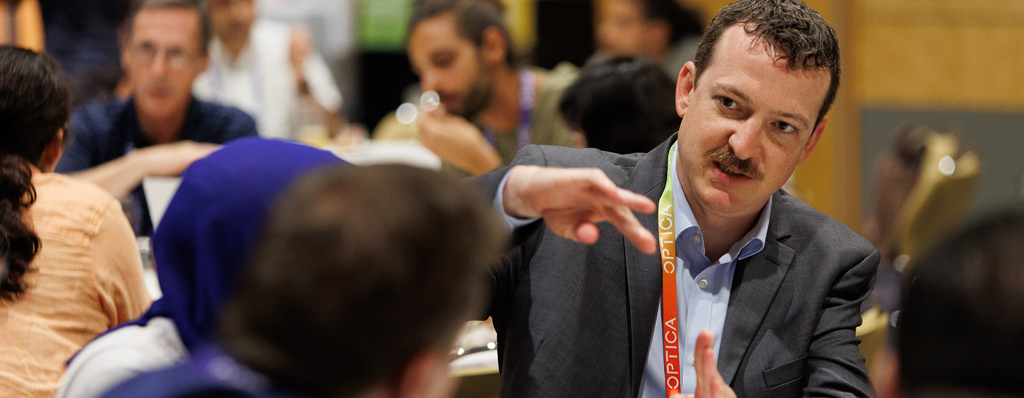
The Industry Chairs have organized an engagement event to provide an opportunity to continue important conversations and to network with industry representatives. The goal of this event is to bring together the participants from both the AI Infrastructure and the Quantum panels to discuss the state of the industry, with an emphasis on needs and challenges.
Following a brief introduction from the Industry Chairs, the panelists will join round table discussions with attendees to discuss and identify critical needs for their respective industries. AI and Quantum, the focus of the industry events, are at turning points in their evolution. Other industries such as Energy, Robotics, and Consumer Electronics, face similar circumstances.
Questions to be discussed during the round table discussions include:
- What are the greatest challenges for scaling?
- Is there a sufficient workforce to support growth? What specific education and workforce development do you foresee?
- Are you concerned with the energy supply?
- What impact are global policies having on your supply chains?
- Is there sufficient R&D funding to advance your industry?
- Does your industry have sufficient standards to enable scaling? If not, why?
Refreshments will be provided during this engagement event and we strongly encourage all participants to use this opportunity to network with our distinguished industry guests.
