2026 Ellis R. Lippincott Award Winner
Get Involved
Jürgen Popp Named the 2026 Ellis R. Lippincott Award Recipient

Optica, the Coblentz Society and the Society for Applied Spectroscopy (SAS) are pleased to announce that Jürgen Popp, Leibniz Institute of Photonic Technology Jena, and Institute of Physical Chemistry and Abbe Center of Photonics, Friedrich-Schiller University Jena, Germany, has been selected as the 2026 recipient of the Ellis R. Lippincott Award. Popp is honored for pioneering work in translational clinical Raman spectroscopy, together with his leadership in establishing Raman as one of the most important analytical approaches, which has transformed the field and inspired worldwide scientific innovation.
Popp is the Chair of Physical Chemistry at Friedrich Schiller University Jena. He also serves as Scientific Director of the Leibniz Institute of Photonic Technology (Leibniz-IPHT) in Jena, where he has built a globally leading research environment in photonic biomedical technologies. He studied chemistry at the Universities of Erlangen and Würzburg and received his PhD in chemistry before undertaking postdoctoral research at Yale University and completed his habilitation at the University of Würzburg.
His research spans the full innovation pipeline - from laser-based spectroscopy and imaging fundamentals to their translation into clinically applicable diagnostic and therapeutic technologies, with particular impact in infection research, oncology, and precision medicine. Under his leadership, photonic approaches with a strong focus on Raman spectroscopic methods have been advanced into powerful tools for label-free, real-time biomedical diagnostics.
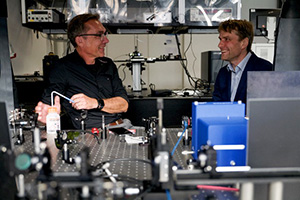 Popp is the author of more than 1,140 peer-reviewed scientific publications, cited over 44,600 times, resulting in an h-index of 88. His work has also led to 21 patents and more than 200 invited talks worldwide, including over 60 keynote and plenary lectures. He has played a central role in shaping the international photonics community, notably as organizer of major conferences such as ICORS, the world’s largest conference on Raman spectroscopy.
He is Editor-in-Chief of the Journal of Biophotonics and Journal of Raman Spectroscopy, a member of the Executive Board of Photonics21, and a frequent advisor to policymakers and media. His additional awards and honors include the Pittsburgh Spectroscopy Award, the Charles Mann Award, and an honorary doctorate from the University at Albany.
Established in 1975, the Lippincott Award is presented to an individual who has made significant contributions to vibrational spectroscopy as judged by their influence on other scientists. The award honors the unique contributions Ellis R. Lippincott made to the field of vibrational spectroscopy. It is jointly presented by Optica, the Coblentz Society and the Society for Applied Spectroscopy.
About Optica
Optica, Advancing Optics and Photonics Worldwide, is the society dedicated to promoting the generation, application, archiving and dissemination of knowledge in the field. Founded in 1916, it is the leading organization for scientists, engineers, business professionals, students and others interested in the science of light. Optica's renowned publications, meetings, online resources and in-person activities fuel discoveries, shape real-life applications and accelerate scientific, technical and educational achievement.
About the Coblentz Society
The Coblentz Society was founded 70 years ago with the purpose of fostering the understanding and application of vibrational spectroscopy and that continues to be their goal today. The non-profit Society is named after Dr. William W. Coblentz, who devoted most of his life to investigating the infrared spectra of “pure” compounds.
About SAS
The Society for Applied Spectroscopy is a non-profit organization dedicated to the dissemination of information related to spectroscopy. In business for over 50 years, the Society is committed to education and to providing quality benefits to members worldwide. The objective of this Society is to advance and disseminate knowledge and information concerning the art and science of spectroscopy and other allied sciences.
