Pi Day
History
3.14159265358979323846264338...we could go on.
Happy Pi Day. Let's celebrate the infinite pawsibilities of mathematics and science together.
Learn about infinity, mathematics in optics, Raspberry Pi-based technology and things that look or sound like "pi."
RESEARCH NEWS
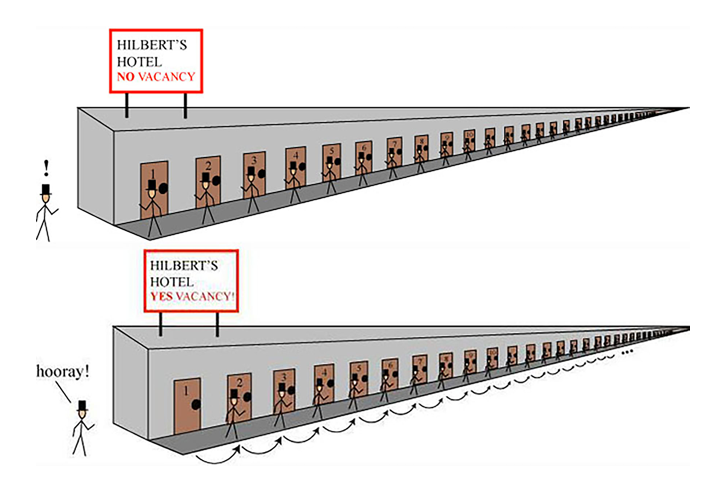
“Hilbert’s Hotel” makes room for optics.
A hotel with infinite space? Hilbert's hotel paradox envisions a hotel in which, even though each of an infinite number of rooms may be occupied, a new guest can always be accommodated by moving all existing guests up by one room.
In this feature, research found that a classical light field can manifest Hilbert's Hotel behavior.
RESEARCH NEWS
No GPS, no problem.
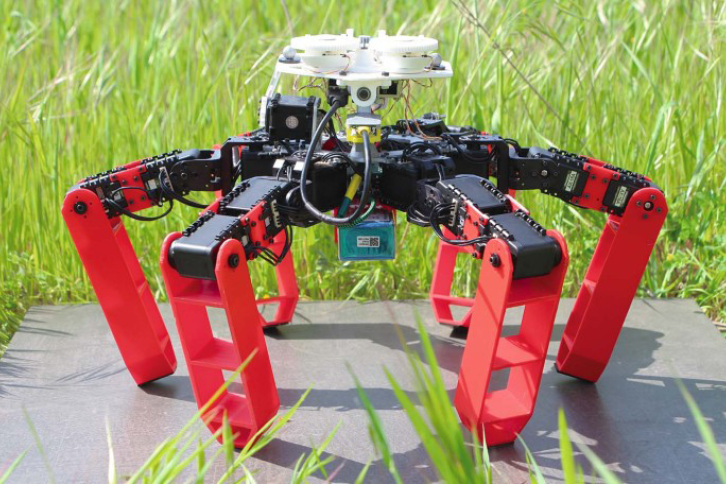
Pi...? No, not π. Path Integration (PI) is a process that ants use to observe the sky’s polarized light!
Inspired by ants, the "AntBot" uses an optical compass to determine its direction via polarized light, and an optical movement sensor directed at the sun measures the distance traveled.
OPN FEATURE
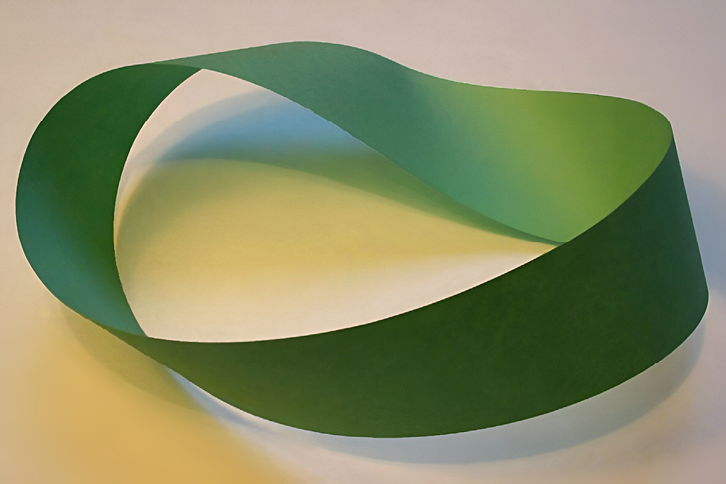
A new control knob for shaping light?
The Berry phase, an extra phase factor that arises when a lightwave passes through a closed-path parameter space, can be exploited for various applications, such as creating optically thick, physically thin optical elements.
When light circulates in a Möbius-strip resonator, the cavity produces a Berry phase factor of π. Now, researchers developed optical Möbius-strip microring resonators that could enable a new generation of on-chip integrable systems with excellent topological robustness.
OPN FEATURE
A geometric-phase timeline.
Global change without local change—a connecting idea in the physics of optical, quantum and other waves—has a multistranded history spanning two centuries.
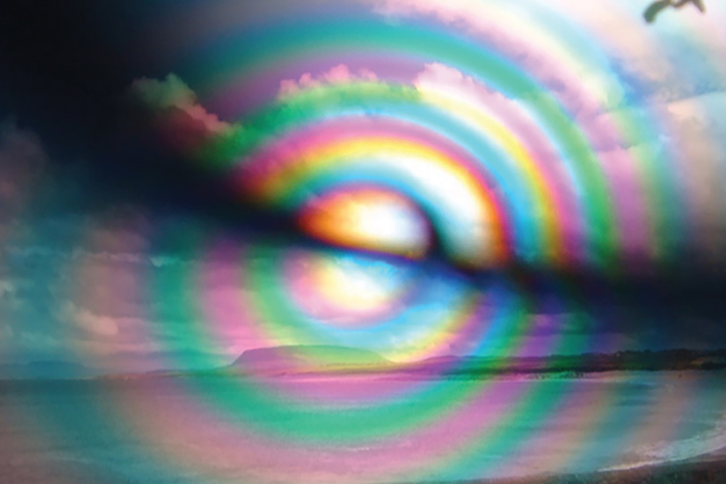
This photo shows a view near Skreen, in the west of Ireland, through a thin crystal sandwiched between crossed polarizers. The dark band across the interference fringes corresponds to a geometric phase of π. [M. Berry].
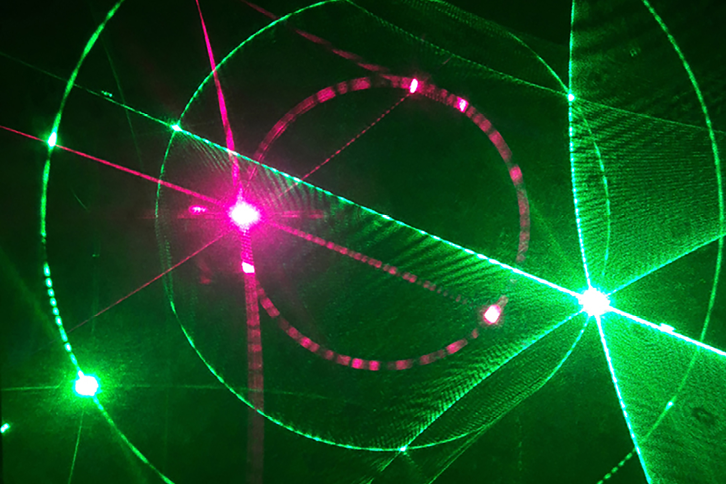
IMAGE OF THE WEEK
Soap halos
Laser scattering in Plateau borders. The “parlaseric circle” is a luminous ring generated by light scattering in foam or soap bubbles. The name was inspired by the atmospheric phenomena known as a parhelic circle.
[OPN 2022 Photo Contest Honorable Mention]
—Adriana P.B. Tufaile, Soft Matter Lab, EACH-University of São Paulo, São Paulo, Brazil
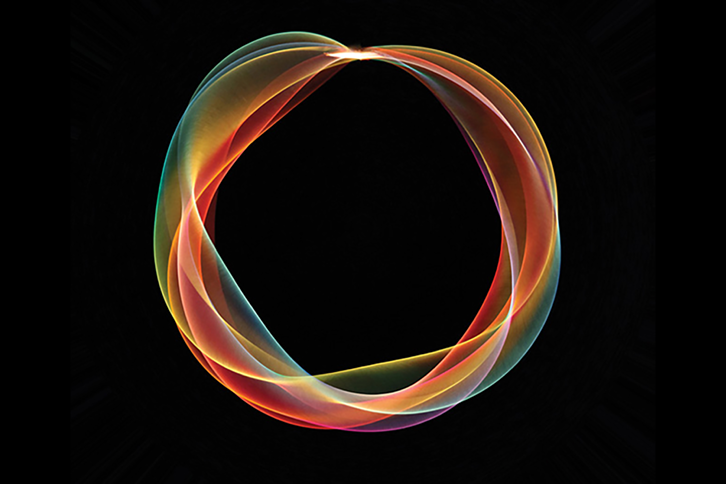
IMAGE OF THE WEEK
Optical Möbius strip
Optical Möbius strip: A string recorded under colored illumination just before a standing wave forms; the photograph was then transformed into polar coordinates.
—Dan Curticapean, University of Applied Sciences Offenburg, Germany
RESEARCH NEWS
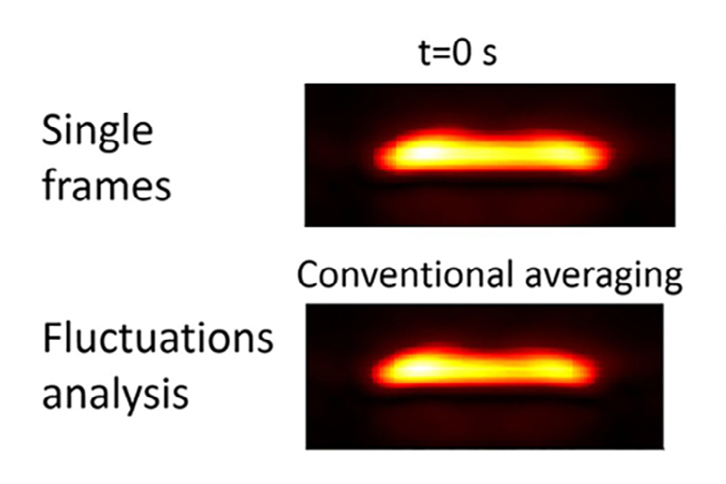
Breaking the acoustic diffraction limit, with math.
Photoacoustic imaging can view structures beyond what optical microscopy can capture, but is limited by acoustic diffraction, which occurs at wavelengths too long to resolve microscopic blood vessels and capillaries below the skin’s surface.
Instead of introducing extra equipment to the matter, researchers applied an old equation to a new problem: Using an advanced statistical temporal fluctuation analysis to increase spatial resolution computationally.

RESEARCH NEWS
Tiny robot crabs controlled with a laser
With a structurally supportive polyimide (PI) skeleton, these peekytoe-like robots can walk, bend, twist, turn and jump via laser remote-control.
In one application, researchers demonstrate the robots' usefulness as wireless environmental sensors by outfitting them with light retroreflectors that triggered them into action when materials in their environment changed color due to variations in humidity or ultraviolet light.
