Keynote Speakers
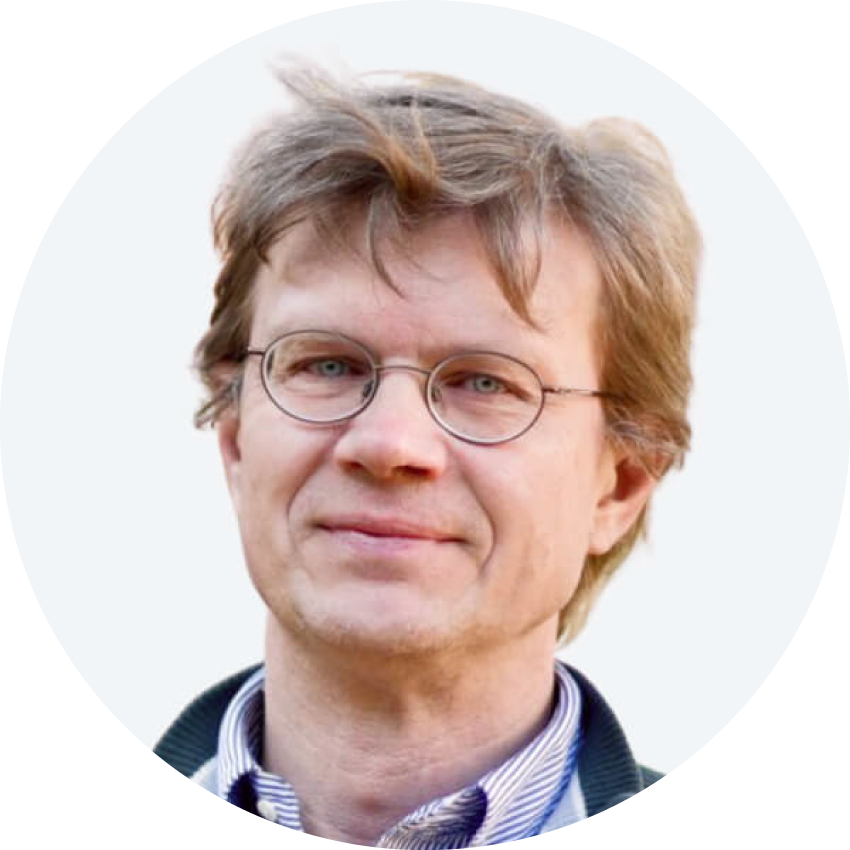
Ronald Hanson
QuTech, NETHERLANDS
Diamond-Based Quantum Networks: From Metropolitan-Scale Demonstrations to a Quantum Internet
This talk will present our ongoing work and future prospects on diamond-based quantum networks. I will first discuss the state of the art, including metropolitan-scale entanglement distribution between qubit chips over deployed fiber and a rudimentary network operating system. I will then discuss the exciting new prospects for scaling these technologies using a novel qubit platform and integrated photonics and show the latest results in this direction.
About the Speaker
Ronald Hanson (1976) is Distinguished Professor at Delft University of Technology and CEO of Delft Networks. He was one of the four founding professors of the interdisciplinary quantum institute QuTech (2014), serving as its Scientific Director in 2016-2020. Ronald was a main driving force in establishing the 7-year, 615MEuro Dutch program Quantum Delta NL, leading the team in the run-up phase and serving as the first chairman of its Executive Board (2021-2023). In 2024 he co-founded Delft Networks to commercialize the university R&D on quantum networks.
Ronald’s academic research focused on developing the fundamentals of a future quantum internet on the road towards large-scale deployment. His work combines quantum optics, solid-state physics, nuclear magnetic resonance, quantum information theory and nanofabrication. Key results from his academic group include teleportation of quantum data between distant chips (2014), the first loophole-free Bell test (2015), the first multi-node entanglement-based quantum network in the lab (2021) and heralded entanglement generation between chips separated by 10km via 25km of deployed optical fiber (2024).
Ronald has received several awards for his work, including the Nicholas Kurti European Science Prize (2012), the John Stewart Bell Prize (2017) and the Physica Prize (2022). In 2019 he received the Spinoza Prize, the highest scientific award in the Netherlands. He is member of the Dutch Royal Academy of Sciences and Fellow of the American Physical Society. In 2020 he was appointed as the university’s 6th Distinguished Professor.
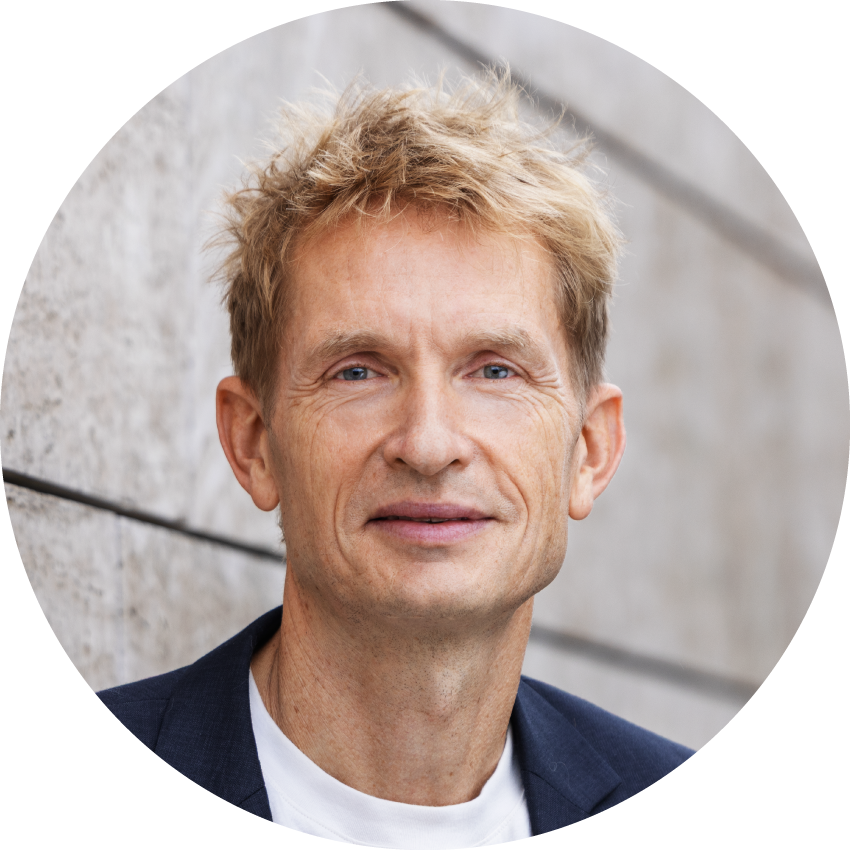
David Lucas
University of Oxford, UNITED KINGDOM
Distributed Quantum Computing Using A Trapped-Ion Quantum Network
In this talk, I will give an introduction to the ideas of quantum networking using trapped ions and describe experimental progress in the Oxford group. Our elementary two-node setup combines "network" qubits, which can be remotely entangled via an optical fibre link, with long-lived memory qubits. Recent work includes demonstrations of distributed gates and algorithms and the generation of multi-particle entangled states, over the network link.
About the Speaker
Professor David Lucas is an experimental atomic physicist at Oxford whose research focuses on trapped‐ion quantum computing. He leads a group working on precision control, coherence, and error reduction in ion trap qubits, pushing toward fault-tolerant quantum logic. Recently his team set a new global benchmark for single-qubit gate fidelity — achieving an error rate of just 0.000015% (one in 6.7 million) — and has demonstrated distributed quantum computation by linking remote ion processors via photonic interfaces.
Andrew Shields
Toshiba Europe, UNITED KINGDOM
Building Quantum‑Safe Networks for a Post‑Quantum World
Quantum computing is advancing at an unprecedented pace, challenging the foundations of security that underpin today’s communication networks. In this talk, we explore how the industry is responding—integrating quantum‑safe technologies such as quantum key distribution, alongside quantum‑resistant algorithms, into commercial metro and national networks. We look beyond today’s deployments to consider what it will take to realise a truly global infrastructure for secure communications and computing in the quantum era.
About the Speaker
Andrew Shields (Vice President, Toshiba Europe Ltd) leads the quantum technology business in Toshiba, which is commercialising solutions for quantum safe communications. Previously he led R&D in Toshiba on quantum technology, publishing over 500 research papers and patents, mainly on quantum photonics and its applications. He was a co-founder of the Industry Specification Group for QKD at ETSI and served as Chair for several years. He is a fellow of the Royal Academy of Engineering and has been awarded the Mott (2013) and Katharine Burr Blodgett (2022) Medals by the Institute of Physics and was elected a Fellow of the Royal Society in May 2026.
Seigo Tarucha
Riken, JAPAN
Improved Performance of Spin-Based Quantum Computing Devices in Silicon
Semiconductor-based QC has rapidly attracted increasing interest. Despite emerging several years later than other hardware platforms, it offers compelling advantages, including the small footprint of qubit devices and fabrication processes compatible with standard CMOS technology. This trend is particularly prominent for silicon spin qubits in quantum dots.
Key challenges toward practical spin-qubit processors include fault-tolerant qubit operation, quantum error correction and scalable qubit architectures. Notably, recent progress in qubit control has enabled single- and two-qubit gate fidelities that exceed commonly discussed fault-tolerance thresholds. Nevertheless, scaling up qubit devices remains one of the central challenges across all quantum computing platforms. For silicon-based approaches, advanced industrial fabrication technologies provide a promising route to accelerate the development of large-scale architectures.
In this talk, I will first review recent advances in improving performance in qubit control fidelities and discuss the dominant error mechanisms that currently limit qubit performance. I will then highlight recent efforts toward scalable device geometries and integration strategies for silicon spin-qubit processors.
About the Speaker
Seigo Tarucha received the B.E. and M.S. degrees in applied physics from the University of Tokyo in 1976 and 1978, respectively. He joined the NTT Basic Research program in applied physics at the University of Tokyo in 1986. In 1998, he moved to the University of Tokyo as a professor in the Department of Physics and then to the Department of Applied Physics in 2005. In March of 2019, he retired from the University of Tokyo, and since then, he has been fully affiliated with the RIKEN Center for Emergent Matter Science (CEMS). He has been running a Quantum Functional System Research Group in CEMS since 2013 and also a Semiconductor Quantum Information Device Research Team in RIKEN Center for Quantum Computing (RQC) since 2019. He was a guest scientist at the Max-Planck-Institute (Stuttgart) in 1986 and 1987 and at TU Delft in 1995. He is currently working on the physics and technology of spin-based quantum computing and topological quantum computing. He received the Japan IBM award in 1998, the Kubo Ryogo award, the Quantum Devices award in 1998, the Nishina award in 2002, the National medal with purple ribbon in 2004, the Leo Esaki Award in 2007, the Achievement award of Japan Applied Physics Society in 2018 and the Fujiwara Award in 2023. He is a fellow of the Japan Applied Physics Society and the IOP.