T Centers in Silicon: An Emerging Platform as a Spin-Photon Interface
This webinar is hosted By: Quantum Optical Science and Technology Technical Group
03 March 2026 15:30 - 16:30
Silicon is a leading platform for scalable integrated photonics and a high-quality host for solid-state spins, yet realizing an efficient spin–photon interface remains challenging.
Professor Zhang will present an integrated photonic platform based on T centers—carbon-hydrogen defects in silicon—operating in the telecom O-band with long spin coherence times. T centers are integrated into photonic crystal cavity (PCC) arrays coupled to a bus waveguide, enabling wavelength-multiplexed emission and revealing cavity–cavity interactions. This architecture supports high-bandwidth entanglement and allows us to identify laser-induced spectral diffusion as the dominant source of linewidth broadening. Finally, Zhang will discuss coherent control and optical readout of electron and nuclear spins, including entanglement among an electron and two nearby nuclear spins, demonstrating a three-spin quantum register. These results mark key steps toward scalable silicon-based quantum networks.
Subject Matter Level: Intermediate - Assumes basic knowledge of the topic
What You Will Learn:
• How T-center defects in silicon enable telecom-band spin–photon interfaces integrated into photonic crystal cavities.
• What limits the T-center linewidth.
• How coherent control of electron and nuclear spins leads to a three-spin quantum register.
Who Should Attend:
• Researchers and engineers working in quantum photonics / integrated photonics, especially those interested in waveguide QED and spin–photon interfaces in silicon
• Scientists developing scalable quantum systems (e.g., superconducting circuits, solid-state spins) and exploring photonic/microwave interconnects to increase system connectivity
About the Presenter: Xueyue Zhang from Columbia University
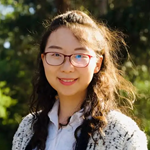 Xueyue (Sherry) Zhang is an Assistant Professor of Applied Physics at Columbia University. She earned her B.Eng. from Tsinghua University and her Ph.D. in Applied Physics from Caltech, followed by a Postdoc training at UC Berkeley. Dr. Zhang's research interests include superconducting circuits, quantum many-body simulations, and color centers in silicon. Her work has earned her several awards, including the Miller Postdoctoral Fellowship, the Boeing Quantum Creator Prize, and the Rising Star in Physics award.
