Connecting in Excellence: The Optica Women Scholars Conference
Foundation
Connecting in Excellence: The Optica Women Scholars Conference
Sydney Lepard
In the male-dominated field of optics, women leaders become accustomed to walking into a room and being the only female present. So when I arrived at the Optica Women Scholars Conference and was among 80 women leaders in a room, it was a notable experience.
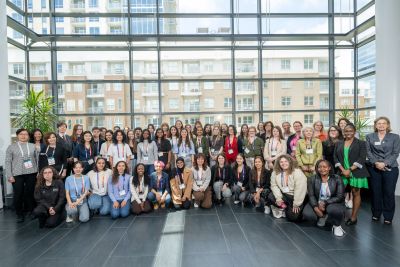 Group photo from the inaugural 2024 Women Scholars Conference hosted at CLEO in Charlotte, North Carolina, USA |
Beyond our shared gender, we also were all professionals with technical backgrounds in varying optics and photonics disciplines
A mentoring mélange
The great part about the rapid-fire mentoring was that we were able to connect with each of these experts for a brief time, and the program was structured so that if you wanted more time to interact, you could approach them throughout the rest of the conference for more of a one-on-one conversation. It enabled a number of new relationships that I look forward to further developing.
Building a network
Those relationships weren’t confined to the mentor–mentee scenario; attendees truly connected with one another as well. In fact, the relationships I made with peers at the conference were probably the most significant takeaway from the event. I’m still in contact with a lot of the women I met. Case in point, I was recently in Berlin, and I met up with Women Scholars Conference connections who live there.
These women have become more than colleagues to me; we’re friends. Beyond that, we’re connected via our career journeys, helping one another chart our courses. In fact, during the Women Scholars Conference, I was chatting with another attendee, and she shared what she wants to do professionally. When she told me about her desire to conduct research on satellites tracking forest fires, I said, “My aunt works for a company that does that. Let me give you her number.” I put her in touch with my aunt, and they’ve been in contact as recently as a few weeks ago. My aunt mentioned that they’d chatted on the phone, so she was able to answer questions and provide some perspective on the industry. What a nice surprise that would never have happened otherwise!
Gaining career insights
That’s exactly the type of relationship the Women Scholars Conference aims to enable. Beyond simply providing us with a host of potential connections at the event, the conference sessions deliver the knowledge and tools that help us learn how to build our professional networks.
For example, there was a session the first year called “How to Network for Engineers,” led by Christina Willis of Infleqtion, which spoke to how to engage. Yet, it didn’t just paint the topic with a broad brush; it dove into specifics like how to handle the dynamics of a mentor–mentee relationship, how to maintain connections but provide appropriate space, and much more. The advice was all useful and tangible; we could take the recommendations and apply them to a number of different professional scenarios.
A role for giving back
The Women Scholars Conference also made me recognize that I have something to offer this community, and I owe that realization to 1997 Optica President Janet Fender. I had met her at the first Women Scholars Conference in 2024, where I was able to have a really meaningful conversation with her about my career path. Then, when I came in 2025, she was there as a quick-fire mentor. I had shared that I was finishing up my master’s degree and wanted to still be involved in academia but wasn’t sure I wanted to pursue a Ph.D., and she encouraged me to consider some of Optica’s mentoring programs. I thought she was referring to me becoming a mentee, but it was the opposite: She was encouraging me to apply to be a mentor. When she realized my confusion, she looked me in the eye and said, “You are ready to give back.”
When you're coming up in the early stages of your career, you don't necessarily feel like you have a lot to offer, so that interaction meant the world to me. It has definitely stuck with me and inspired me to seek out ways I can help in this community, both immediately and for years to come.
The future is bright for women in optics
As I reflect on the Optica Women Scholars Conference, I realize how lucky I am to have been connected to all of these amazing women. We all excel in our careers and have the same kind of commitment and motivation. We are all exceptionally passionate about what we do and are good at it . You put all of us in a room, and you see that there's a huge degree of technical ability. It’s empowering to be around such a microcosm of strength and opportunity. I am looking forward to the possibility of attending again in the future and to supporting women across our industry.
So while it’s easy to say that optics is a male-dominated field, when you look around at this event, you realize there is an abundance of qualified, smart, successful women in the mix. In fact, Optica reported it had more than 800 applications for the Women Scholars Program, and the organization had to select only 20 recipients. When you think about it from that perspective, women in optics are not really a scarce resource at all. There are more female science and engineering leaders than we think, and that is a point worth remembering. Because with foundation programs like the Optica Women Scholars Conference in place, those numbers will continue to climb.
Sydney Lepard is a junior test engineer at MDA Space, a defense and space manufacturer headquartered in Brampton, Ontario, Canada, and a 2024 Optica Women Scholar.
